How to Earn Crypto with DePIN in 2026: A Step-by-Step Guide
Affiliate Disclosure: This article may contain affiliate links. We may earn a commission at no extra cost to you. All opinions are our own.
Marcus Chen
Senior Crypto Analyst & Educator
Certified Blockchain Professional | Former Wall Street Analyst
Marcus Chen is a cryptocurrency analyst and educator with over 8 years of experience in digital asset trading. He has helped thousands of beginners navigate the crypto markets through practical, actionable education.

How to Earn Crypto with DePIN in 2026: A Step-by-Step Guide
If you want to earn crypto with DePIN — Decentralized Physical Infrastructure Networks — 2026 is arguably the best time to start. The sector has quietly grown into a $15+ billion market, and unlike trading or yield farming, DePIN lets you generate token rewards by contributing something you probably already have: spare bandwidth, storage space, GPU cycles, or even your daily commute. No charts to watch. No liquidation risk. Just real-world resources turned into digital income. This guide breaks down exactly how DePIN works, which projects are worth your attention, and the step-by-step process to get started.
What Is DePIN and Why It Matters in 2026
DePIN stands for Decentralized Physical Infrastructure Networks. The concept is straightforward: instead of a corporation like Amazon or AT&T owning and operating the servers, cell towers, and data pipelines that power the internet, DePIN projects distribute that infrastructure across thousands of individual contributors — and pay them in crypto for doing so.
Think of it as the gig economy for physical infrastructure. You're not driving for Uber; you're running a wireless hotspot, renting out hard drive space, or sharing your GPU. The blockchain handles verification, payment, and coordination automatically.
Why does this matter in 2026? AI companies need massive amounts of compute, bandwidth, and training data — DePIN networks like Grass and Render are filling that gap at a fraction of centralized costs. Unlike many crypto projects that rely purely on token inflation, leading DePIN networks now generate income from actual enterprise customers: mapping firms, AI labs, telecom operators. Bittensor (TAO), Render (RENDER), Filecoin (FIL), and Grass (GRASS) are among the top performers in a sector that has crossed $15 billion in market cap. This isn't speculative anymore — DePIN is infrastructure, and infrastructure tends to stick around.
How DePIN Earning Works: The Proof-of-Resource Model
Traditional crypto mining uses Proof-of-Work: you burn electricity solving puzzles, and the network rewards you. DePIN uses a different model — Proof-of-Resource. You prove you're providing a useful service (bandwidth, storage, compute, coverage), and the protocol pays you accordingly.
Each project has its own verification mechanism:
- Proof-of-Coverage (Helium): Hotspots verify each other's location and signal strength through cryptographic challenges.
- Proof-of-Spacetime (Filecoin): Storage nodes prove they're reliably holding client data over time.
- Proof-of-Bandwidth (Grass): The network verifies that your device is actively routing AI data requests.
- Proof-of-Render (Render): GPU nodes submit completed rendering jobs that clients can verify.
The key insight: you're not competing against other miners in a zero-sum race. You're providing a service, and the protocol pays you based on the quality and quantity of that service. More coverage in an underserved area? Higher rewards. Faster GPU? More jobs routed your way.
Top DePIN Projects to Earn Crypto in 2026
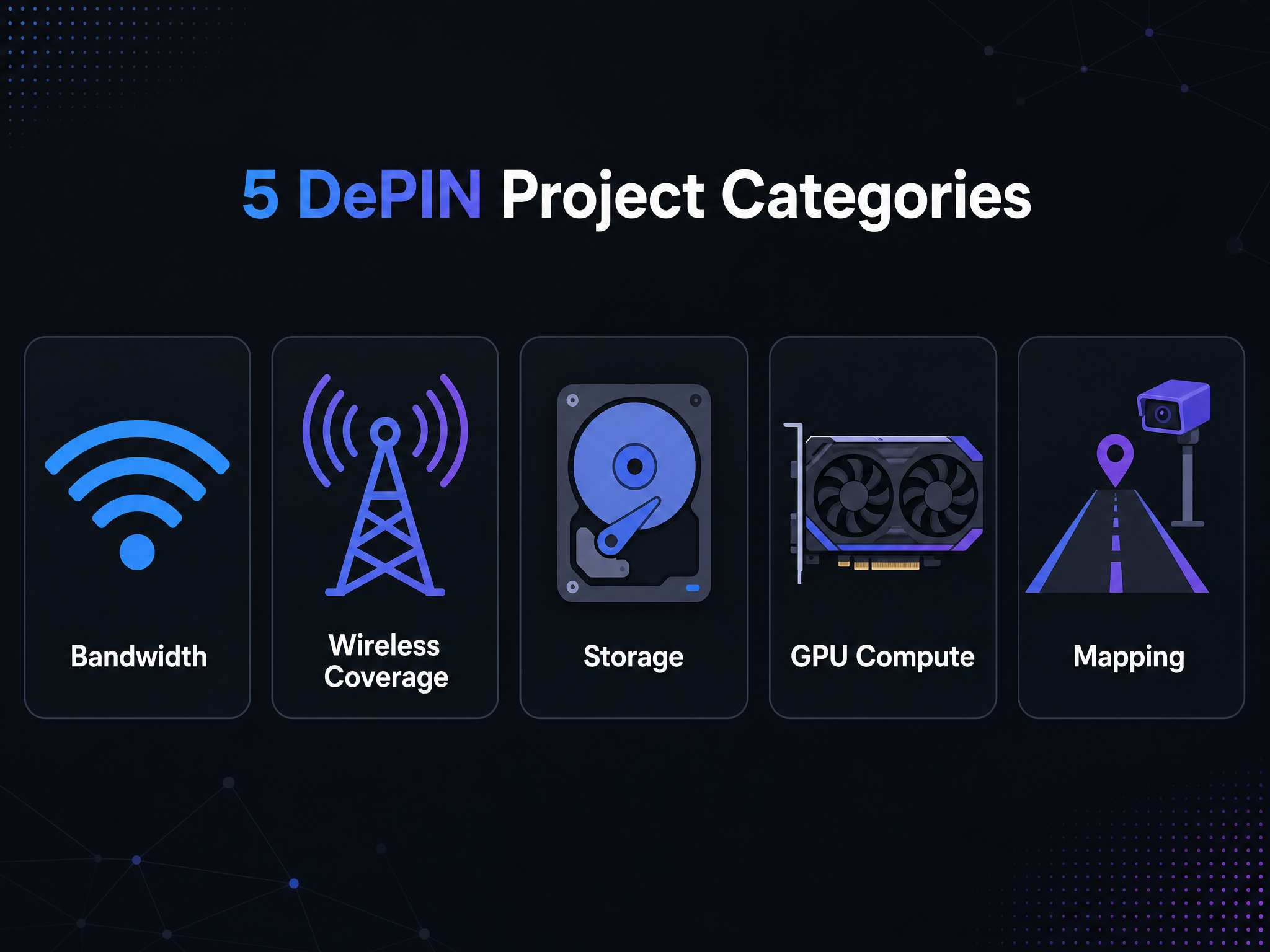
Not all DePIN projects are created equal. Here's a breakdown of the five most established networks, what resource they need, and what you can realistically earn.
Grass — Earn by Sharing Bandwidth
Grass is probably the lowest-barrier DePIN project available right now. You install a browser extension or desktop app, and it routes AI data collection requests through your idle internet connection. That's it. No hardware to buy, no technical setup beyond a five-minute install.
The network sells this bandwidth to AI companies that need to scrape and process web data at scale. In return, you earn GRASS tokens. Earnings vary based on your connection speed and uptime, but the appeal is obvious: it runs silently in the background while you do other things.
Best for: Anyone with a decent broadband connection and a computer that's on most of the day.
Hardware required: None beyond a standard PC or Mac.
Token: GRASS (Solana-based)
Helium — Earn HNT with Wireless Coverage
Helium is the OG of DePIN. You deploy a Hotspot device — a small, low-power radio transmitter — and it provides wireless coverage for IoT devices and, more recently, 5G mobile users. The network rewards you in HNT tokens based on how much coverage you provide and how much data passes through your hotspot.
The catch: earnings have compressed significantly as the network has grown. In 2021, early hotspot operators were pulling in hundreds of dollars per month. In 2026, most urban hotspots earn $5–$30/month in HNT. The real opportunity is in underserved areas where coverage is sparse and demand is high.
Best for: People in suburban or rural areas with good line-of-sight placement options.
Hardware required: Helium-compatible hotspot ($300–$600 upfront).
Token: HNT / MOBILE
Filecoin — Earn FIL with Storage
Filecoin is a decentralized storage marketplace. Clients pay FIL to store data; storage providers earn FIL by reliably hosting that data. The network uses cryptographic proofs to verify that providers are actually storing what they claim.
This is the most technically demanding DePIN option. You need significant hardware, a meaningful amount of FIL locked as collateral, and the technical chops to run a storage node. Not for beginners — but the earning potential is higher for those who can manage it.
Best for: Technical users with existing server infrastructure.
Hardware required: High-capacity storage server + FIL collateral.
Token: FIL
Render — Earn RENDER with GPU Power
Render connects GPU owners with creators and AI developers who need rendering power. If you have a high-end NVIDIA GPU sitting idle, you can connect it to the Render network and earn RENDER tokens for completed jobs — 3D animations, AI image generation, video processing.
Earnings scale directly with GPU quality. An RTX 4090 will earn significantly more than a mid-range card. The network has seen strong demand growth as AI image and video generation has gone mainstream, making this one of the more compelling DePIN opportunities for gamers and creators who already own powerful hardware.
Best for: Gamers, 3D artists, or anyone with a high-end GPU.
Hardware required: NVIDIA GPU (RTX 3080 or better recommended).
Token: RENDER (Solana-based)
Hivemapper — Earn HONEY by Mapping Roads
Hivemapper is building a decentralized alternative to Google Maps. Mount a specialized 4K dashcam in your car, drive your normal routes, and the camera automatically uploads road imagery to the network. You earn HONEY tokens based on data freshness and quality — it's genuinely passive once set up. The network sells this data to logistics companies and autonomous vehicle developers.
Best for: Daily commuters, delivery drivers, or anyone who drives frequently.
Hardware required: Hivemapper dashcam (~$550).
Token: HONEY
For a structured approach to learning crypto trading alongside your DePIN income, Icoinpro offers step-by-step training that has helped thousands of beginners build a complete crypto strategy.
Step-by-Step: How to Get Started with DePIN
Here's the process, regardless of which project you choose:
- Choose your resource type. Be honest about what you have. Spare bandwidth? Start with Grass. A high-end GPU? Look at Render. A good location for wireless coverage? Explore Helium. Match the project to your existing assets — don't buy hardware speculatively until you've done the math.
- Set up a compatible wallet. Most DePIN projects run on Solana (Grass, Render, Hivemapper) or have their own chain (Helium, Filecoin). Download Phantom wallet for Solana-based projects. For Helium, the Helium Wallet app handles everything. Keep a small amount of SOL or the native token for transaction fees.
- Register your node or device. Each project has an onboarding process. For Grass, it's installing the browser extension and connecting your wallet. For Helium, you register your hotspot on the Helium Explorer and configure it via the app. For Render, you download the RNDR client and connect your GPU. Follow the official documentation — not third-party tutorials, which may be outdated.
- Optimize your setup. For Helium, placement matters enormously — higher elevation and clear line-of-sight to other hotspots dramatically increases earnings. For Grass, maximize uptime by running it on a machine that stays on. For Render, ensure your GPU drivers are current and your system is stable.
- Monitor with network explorers. Use DePINscan.io to track network growth and saturation in your area. For Helium, the Helium Explorer shows hotspot earnings and coverage maps. Check these before committing to hardware purchases.
- Manage your earned tokens. Decide upfront whether you'll hold, sell, or reinvest your earnings. DePIN tokens are volatile. Many participants sell a portion regularly to cover electricity and hardware costs, then hold the rest as a long-term position.
Protect your earned tokens with a Ledger hardware wallet — the gold standard in cold storage security. Once your DePIN earnings accumulate, moving them off exchanges and into cold storage is the smart move.
DePIN Earnings: What to Realistically Expect
DePIN is not a get-rich-quick scheme. Here's a realistic picture of what participants are earning in mid-2026:
- Grass: $5–$40/month depending on connection speed and uptime. Low effort, low reward — but it's genuinely passive.
- Helium (urban): $5–$30/month in HNT. Earnings have compressed significantly from early days. Rural/suburban placements can earn more.
- Helium (underserved area): $50–$200/month is possible with strategic placement and high data transfer.
- Render (RTX 4090): $50–$300/month depending on job volume. Highly variable based on network demand.
- Hivemapper: $20–$80/month for regular commuters in areas with low existing coverage.
- Filecoin (storage provider): Highly variable; requires significant capital and technical investment to be profitable.
These numbers are in token terms — actual USD value fluctuates with token prices. The real upside scenario is if you accumulate tokens during a period of low prices and they appreciate significantly. That's happened before in DePIN (early Helium operators made fortunes), but it's not guaranteed.
Risks You Need to Know Before You Start
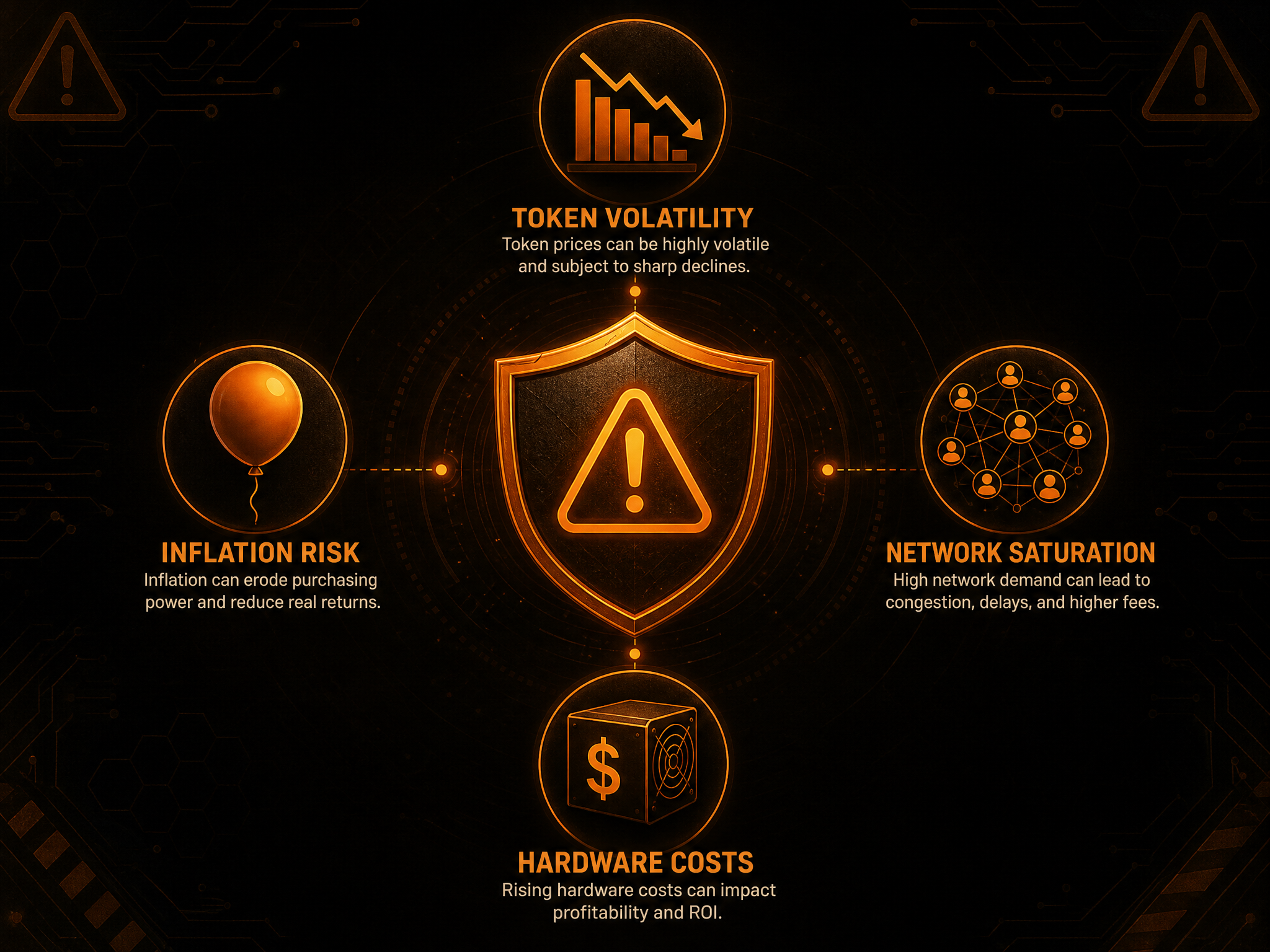
Here's what to watch for before committing capital:
Token volatility. Your earnings are denominated in tokens that can drop 50–80% in a bear market. If you've invested in hardware expecting $200/month in earnings, a token price crash can make that $40/month — potentially below your electricity costs.
Network saturation. As more participants join, rewards per node decrease. Helium is the clearest example: early operators earned 10x what current operators earn. Always check current network density before buying hardware.
Hardware depreciation. Physical devices wear out, become obsolete, or get superseded by newer models. Factor in depreciation when calculating ROI.
Inflation vs. real yield. Some DePIN projects pay rewards primarily through token inflation rather than real revenue from customers. This is unsustainable long-term. Prioritize projects with verifiable enterprise customers and on-chain revenue metrics.
Scams and phishing. The DePIN space attracts scammers selling fake hardware or fake node software. Only buy hardware from official project stores or verified retailers. Never enter your seed phrase into any node software.
Looking for reliable crypto storage for your DePIN earnings? Trezor wallets have been trusted by millions since 2014 and offer excellent security for multi-chain portfolios.
Key Takeaways
- DePIN lets you earn crypto by contributing real-world resources — bandwidth, storage, GPU power, wireless coverage, or mapping data.
- The sector has grown to $15+ billion in market cap, with real enterprise revenue from AI companies, logistics firms, and telecom operators.
- Grass is the lowest-barrier entry point (just a browser extension). Render and Helium require hardware investment but offer higher earning potential.
- Realistic monthly earnings range from $5 to $300+ depending on the project, your hardware, and your location.
- Key risks: token volatility, network saturation, hardware costs, and inflation-based rewards. Always verify real revenue before committing capital.
- Use DePINscan.io to research network density in your area before buying any hardware.
About the Author
Marcus Chen is a Senior Crypto Analyst & Educator with 8+ years of experience in digital assets and blockchain technology. A Certified Blockchain Professional and Former Wall Street Analyst, Marcus has guided thousands of investors through crypto market cycles. His analysis focuses on practical, evidence-based strategies for building long-term crypto wealth.
DeFi moves fast. Your trading skills need to keep up.
Whether you're yield farming or trading tokens, the fundamentals of reading charts, managing risk, and timing entries apply everywhere in crypto. Those skills are worth developing properly.
The program I recommend to people who ask me is this crypto trading course — it\'s the one I point friends and family to when they\'re serious about learning. Daily lessons, live analysis, and a community that actually helps.
Affiliate link — I may earn a commission at no extra cost to you. I only recommend what I genuinely use.
Disclaimer: The information provided on this website is for educational and informational purposes only. It should not be considered financial or investment advice. Cryptocurrency investments carry significant risk. Always do your own research and consult with a qualified financial advisor before making investment decisions.
Free Crypto Insights
Get weekly trading tips, market analysis, and exclusive strategies delivered to your inbox.