How to Use EigenLayer Restaking in 2026: Earn Extra ETH Yield
Affiliate Disclosure: This article may contain affiliate links. We may earn a commission at no extra cost to you. All opinions are our own.
Marcus Chen
Senior Crypto Analyst & Educator
Certified Blockchain Professional | Former Wall Street Analyst
Marcus Chen is a cryptocurrency analyst and educator with over 8 years of experience in digital asset trading. He has helped thousands of beginners navigate the crypto markets through practical, actionable education.

2026 Update: EigenLayer's Reward Model Has Matured
EigenLayer has evolved significantly since this guide was first published. The protocol has moved away from speculative points-based incentives toward a mature reward model tied to real network usage. Here's what's changed.
Productive Stake Priority: EigenLayer now prioritizes "productive stake" — tokens actively securing live Actively Validated Services (AVSs) — over passive holding. If your restaked ETH isn't actively securing an AVS, your reward rate drops. This is a fundamental shift from the early airdrop-farming era.
Fee Model and Buybacks: A new fee mechanism directs revenue from AVS rewards and EigenCloud services (EigenDA, EigenAI, EigenCompute) toward EIGEN token buybacks. This creates a direct link between network usage and token value accrual — a significant improvement over pure emission-based models.
Yield Expectations in 2026: Active restakers earn base Ethereum staking yield (~3–4% APR) plus AVS rewards, for a total of 5–8.5% APR in typical strategies. Aggressive multi-AVS strategies can reach 10%+, but compound slashing risk increases proportionally.
AVS Ecosystem Growth: Beyond EigenDA, the ecosystem now includes EigenAI (AI verification), EigenCompute (off-chain execution verification), and infrastructure for bridges and DePIN networks. The diversity of AVSs means more yield opportunities — and more due diligence required on operator selection.
Risk reminder: Restakers face dual slashing risk — standard Ethereum slashing plus AVS-specific slashing. Smart contract complexity across multiple layers (EigenLayer core, LRT protocols, individual AVS contracts) remains the primary technical risk. Never restake more than you can afford to lose. For context on broader DeFi yield strategies, see our guide to Best Crypto Lending Platforms 2026.
Frequently Asked Questions
What is EigenLayer restaking in simple terms?
Restaking lets you use your already-staked ETH to simultaneously secure additional blockchain services (called AVSs), earning extra yield on top of your base Ethereum staking rewards. Think of it as your staked ETH doing double duty.
How much can I earn from EigenLayer restaking in 2026?
Active restakers typically earn 5–8.5% APR total (base ETH staking yield of 3–4% plus AVS rewards). Aggressive multi-AVS strategies can reach 10%+, but come with higher slashing risk.
What is the difference between native restaking and liquid restaking?
Native restaking requires 32 ETH and running your own validator infrastructure. Liquid restaking tokens (LRTs) like eETH or rsETH from protocols like Ether.fi or Renzo let you participate passively with any amount of ETH, but add smart contract risk from the LRT protocol layer.
What is slashing risk in EigenLayer?
Slashing is a penalty applied when a validator or operator misbehaves. With EigenLayer, you face dual slashing risk: standard Ethereum slashing (for validator misbehavior) plus AVS-specific slashing (if the operator securing an AVS acts maliciously or fails to maintain uptime).
What are EigenLayer AVSs?
AVSs (Actively Validated Services) are the services that restaked ETH secures. Examples include EigenDA (data availability), EigenAI (AI computation verification), EigenCompute (off-chain execution), and various bridge and DePIN infrastructure projects.
How to Use EigenLayer Restaking in 2026: Earn Extra ETH Yield
This article on EigenLayer restaking contains affiliate links. We may earn a commission at no extra cost to you if you make a purchase through these links. See our affiliate disclosure for details.
EigenLayer restaking has quietly become one of the most talked-about yield strategies in crypto. If you already hold staked ETH, you're leaving money on the table by not exploring it. The concept is straightforward: take your staked ETH and put it to work securing additional blockchain services — earning layered rewards in the process. By 2026, EigenLayer has matured from an experimental protocol into core DeFi infrastructure, with billions locked and dozens of Actively Validated Services (AVSs) running on top of it.
This guide walks you through exactly how EigenLayer restaking works, how to get started using EtherFi (the most beginner-friendly route), what yields to realistically expect, and — critically — what risks you need to understand before committing any funds.
What Is EigenLayer Restaking? (And Why It Matters in 2026)
Standard Ethereum staking earns you around 3–4% APR for helping validate the network. That's decent — but restaking lets you do more with the same capital.
EigenLayer is a protocol built on Ethereum that lets you "re-pledge" your already-staked ETH (or Liquid Staking Tokens like stETH) to secure additional decentralized services. These services — called Actively Validated Services, or AVSs — include oracle networks, cross-chain bridges, data availability layers, and AI inference verification systems. They need distributed validation but don't want to bootstrap their own validator sets from scratch. EigenLayer solves that by letting them borrow Ethereum's existing economic security.
For you as a staker, this means extra yield on top of your base staking rewards. By 2026, the protocol secures dozens of AVSs and holds tens of billions in restaked assets. It's no longer a niche experiment — it's infrastructure.
How EigenLayer Restaking Works: The Core Mechanics
Before you deposit a single wei, it helps to understand the moving parts. There are three key actors in the EigenLayer ecosystem:
- Restakers — that's you. You deposit ETH or LSTs and delegate to an operator.
- Operators — entities that run node software for one or more AVSs. They compete for delegations based on reliability and the number of services they support.
- AVSs — the protocols that pay for security. Each AVS defines its own validation logic, reward structure, and slashing conditions.
Native Restaking vs. Liquid Restaking
There are two ways to restake, and they're not equally accessible:
Native Restaking is for solo validators running their own Beacon Chain node. You point your withdrawal credentials to an EigenPod contract, which lets EigenLayer enforce slashing directly on your staked ETH. Capital-efficient, but you need 32 ETH and technical know-how. Most retail users skip this.
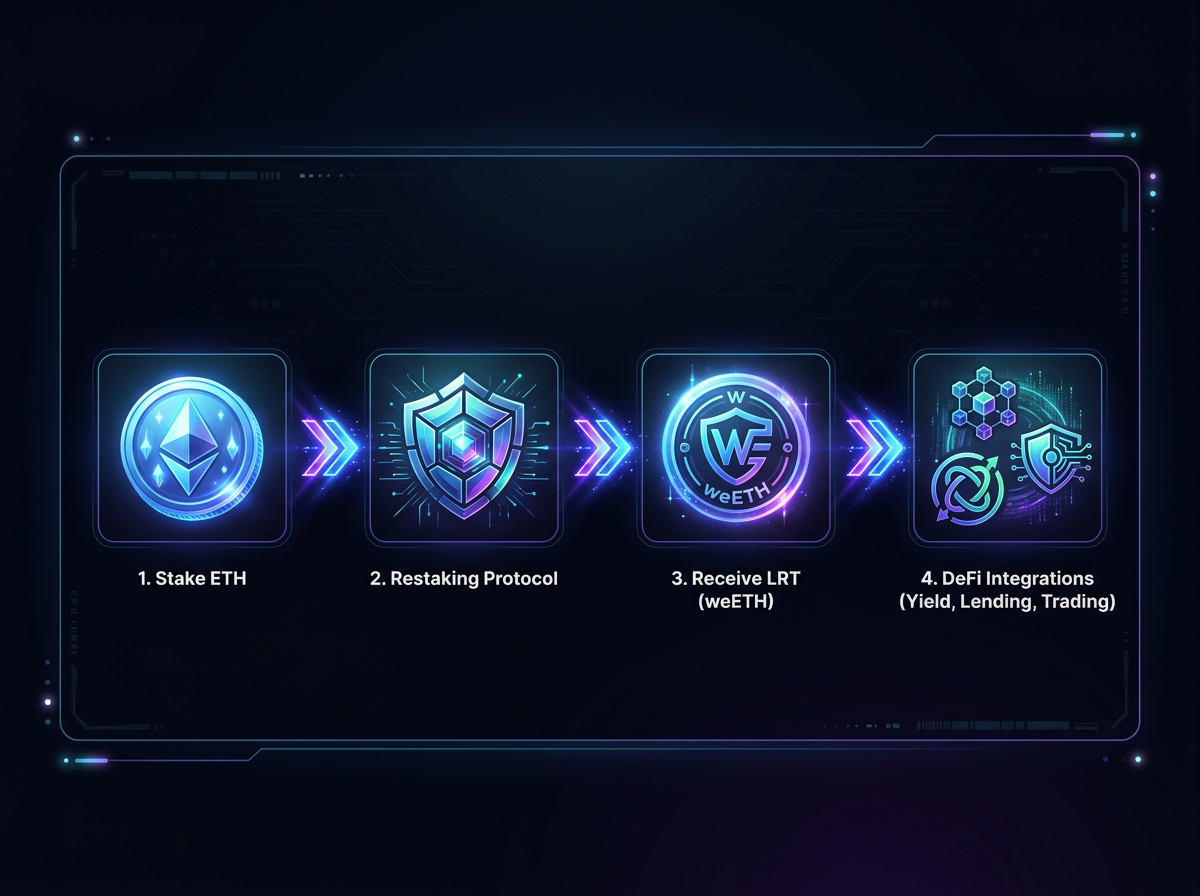
Liquid Restaking is the practical option for most people. You deposit ETH or an LST (like stETH or rETH) into a liquid restaking protocol — EtherFi, Kelp DAO, or Renzo are the main players. The protocol handles delegation and AVS selection, and you receive a Liquid Restaking Token (LRT) in return. That LRT can then be deployed in other DeFi protocols for additional yield. It's restaking with training wheels, in the best possible way.
What Are Actively Validated Services (AVSs)?
AVSs are the reason restaking exists. Think of them as protocols that need security but don't want to build it from scratch. EigenDA (a data availability layer), Omni Network (cross-rollup communication), and Brevis (a ZK coprocessor) are among the notable AVSs live in 2026. The trend is toward specialized "Vertical AVSs" focused on specific validation types — including AI inference verification, which is a fast-growing category.
Each AVS pays operators (and by extension, restakers) for their security contribution. The more AVSs your operator validates, the more reward streams flow back to you.
How to Restake ETH Using EtherFi (Step-by-Step)
EtherFi is the most user-friendly entry point for liquid restaking. Here's the exact process:
- Prepare your wallet. You'll need ETH on Ethereum mainnet in a non-custodial wallet (MetaMask, Coinbase Wallet, or Rabby all work). Keep a small ETH buffer for gas — typically $5–15 worth at current prices.
- Navigate to app.ether.fi. Always verify the URL. Bookmark it. Phishing sites targeting restaking protocols are common.
- Connect your wallet. Click "Connect Wallet" and approve the connection request.
- Choose your deposit token. You can deposit native ETH directly. EtherFi handles the staking and restaking on your behalf.
- Select your output token. You'll receive either eETH (a rebasing token that automatically reflects rewards) or weETH (a wrapped, non-rebasing version). For DeFi use, weETH is generally preferred — it's compatible with more protocols.
- Enter your deposit amount. Start small if this is your first time. Even 0.1 ETH lets you test the flow without significant exposure.
- Confirm the transaction. Review the gas estimate and confirm in your wallet. The transaction typically settles in under a minute.
- Verify your position. Once confirmed, weETH appears in your wallet. It automatically accrues base staking rewards plus restaking rewards from EigenLayer AVSs.
That's it. EtherFi handles operator selection, AVS delegation, and reward distribution in the background. You hold weETH and earn passively.
Want to accelerate your trading journey? Explore Icoinpro's daily trading signals and education platform — a solid complement to any DeFi yield strategy.
How to Restake Directly on EigenLayer
If you prefer more control — or already hold an LST like stETH — you can restake directly through EigenLayer's app:
- Go to app.eigenlayer.xyz and connect your wallet.
- Select your LST (stETH, rETH, cbETH, and others are supported).
- Approve the token for spending, then deposit into EigenLayer's strategy contracts.
- Choose an operator to delegate to. This is the most important decision. Look for operators with strong track records, transparent AVS selections, and reasonable commission rates. EigenLayer's app shows operator stats — use them.
- Confirm the delegation transaction.
Direct restaking gives you granular control over which operator you trust with your capital. The tradeoff: you're responsible for monitoring your operator's performance and slashing risk. Liquid restaking protocols like EtherFi abstract this away, but at the cost of some flexibility.
Protect your crypto assets with a Ledger hardware wallet — the gold standard in cold storage security. When you're managing restaking positions worth thousands, keeping your private keys offline is non-negotiable.
Yield Stacking: What Returns Can You Realistically Expect?
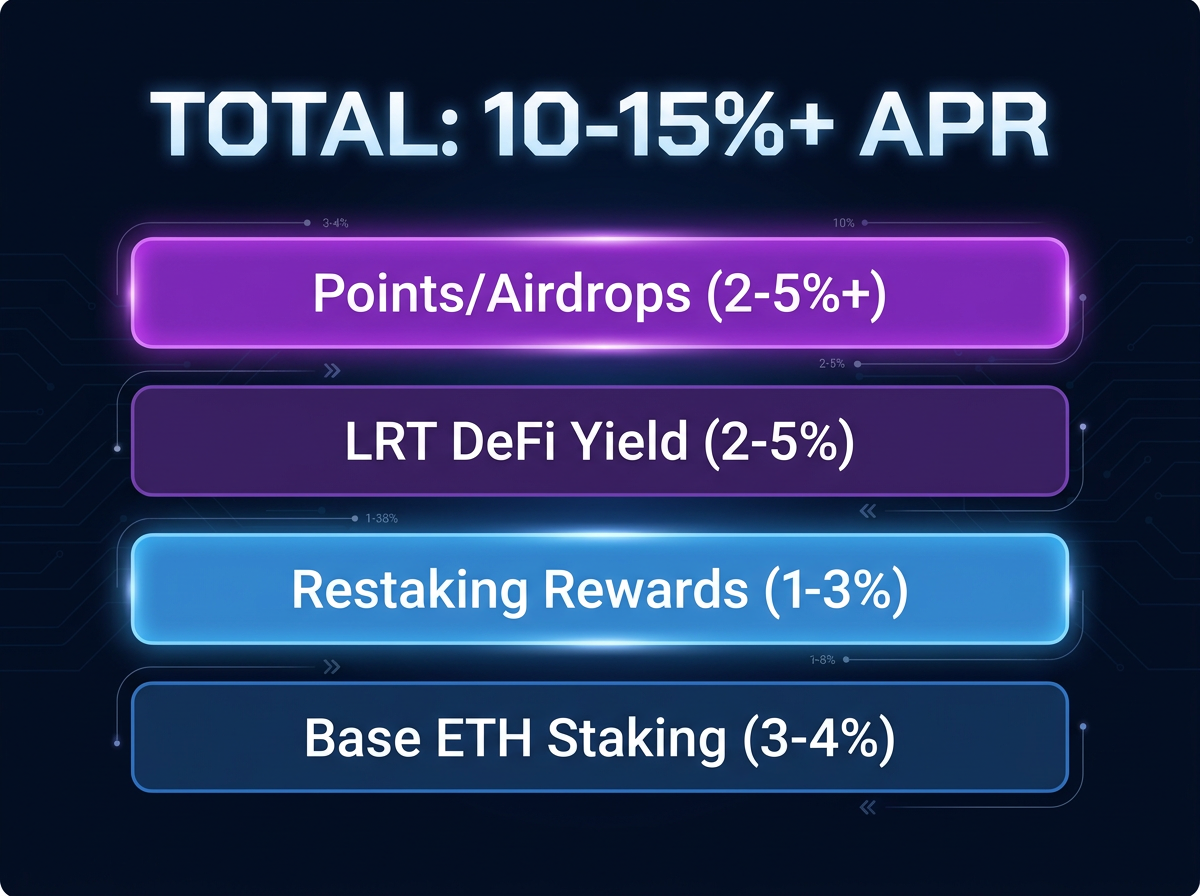
Here's where it gets interesting. Restaking enables "yield stacking" — multiple reward layers from the same underlying ETH. A well-optimized position in 2026 can realistically generate 10–15% APR or more:
| Yield Layer | Source | Estimated APR |
|---|---|---|
| Base ETH Staking | Beacon chain consensus + execution rewards | 3–4% |
| Restaking Rewards | AVS payments for securing additional services | 1–3% |
| LRT DeFi Yield | Lending, LP, or collateral usage of LRTs | 2–5% |
| Points / Airdrops | Protocol incentive programs and token distributions | 2–5%+ (variable) |
| Total Estimated | 10–15%+ |
A few caveats: these numbers aren't guaranteed. AVS reward rates fluctuate based on demand. Airdrop yields are speculative and can be zero. And DeFi yields on LRTs depend on market conditions. The 3–4% base staking yield is the most reliable component — everything above that is variable.
That said, even the conservative scenario (base staking + modest restaking rewards, no DeFi deployment) puts you at 4–7% APR. That's meaningfully better than holding plain ETH.
Risks You Must Understand Before Restaking
Restaking is not free money. The additional yield comes with real, compounded risk. Here's what you're taking on:
Slashing risk — doubled. You're now subject to slashing penalties on both Ethereum's base layer and any AVS your operator validates. If an operator acts maliciously or makes a critical error on an AVS, a portion of your restaked ETH can be seized. This is the biggest risk, and it's not theoretical — slashing events have happened on other protocols.
Operator selection risk. Your returns and your safety depend heavily on which operator you delegate to. A negligent operator can get slashed even without malicious intent. Research operators carefully: look at their track record, the AVSs they've opted into, and their commission structure.
Smart contract risk. Your funds interact with multiple contracts — EigenLayer's strategy contracts, the AVS contracts, and (if using liquid restaking) the LRT protocol's contracts. Each is a potential failure point. EigenLayer has been audited extensively, but no smart contract is 100% bulletproof.
Withdrawal timing. Unstaking is not instant. Exits can take days or weeks, which can trap funds during market stress. If ETH drops 30% and you need to exit quickly, you may not be able to.
LRT peg risk. Liquid restaking tokens like ezETH have experienced brief de-pegging events during market volatility. If you're using LRTs as collateral in DeFi, a de-peg can trigger liquidations.
The bottom line: restaking is appropriate for ETH holders with a long time horizon who understand and accept these risks. It's not a set-and-forget savings account.
Is EigenLayer Restaking Right for You?
Restaking makes sense if you already hold staked ETH and want incremental yield, you're comfortable with the additional slashing and smart contract risks, you can afford to have funds locked for extended periods, and you're willing to research operators or trust an LRT protocol's selection process.
It's probably not right for you if you need immediate liquidity, you're new to DeFi and still learning the basics, or the additional yield doesn't justify the complexity and risk for your situation.
For a structured approach to learning crypto trading, Icoinpro offers step-by-step training that has helped thousands of beginners build the foundational knowledge needed before venturing into advanced DeFi strategies like restaking.
Key Takeaways
- EigenLayer restaking lets you re-pledge staked ETH to secure additional blockchain services (AVSs), earning layered rewards on top of base staking yield.
- Liquid restaking via EtherFi is the most accessible entry point — deposit ETH, receive weETH, earn automatically.
- Realistic yields range from 4–7% (conservative) to 10–15%+ (with DeFi deployment and airdrop participation).
- Key risks include compounded slashing, operator selection, smart contract vulnerabilities, and withdrawal delays.
- Start small, research your operator, and never restake funds you can't afford to have locked for weeks.
DeFi moves fast. Your trading skills need to keep up.
Whether you're yield farming or trading tokens, the fundamentals of reading charts, managing risk, and timing entries apply everywhere in crypto. Those skills are worth developing properly.
The program I recommend to people who ask me is this crypto trading course — it\'s the one I point friends and family to when they\'re serious about learning. Daily lessons, live analysis, and a community that actually helps.
Affiliate link — I may earn a commission at no extra cost to you. I only recommend what I genuinely use.
Disclaimer: The information provided on this website is for educational and informational purposes only. It should not be considered financial or investment advice. Cryptocurrency investments carry significant risk. Always do your own research and consult with a qualified financial advisor before making investment decisions.
Free Crypto Insights
Get weekly trading tips, market analysis, and exclusive strategies delivered to your inbox.