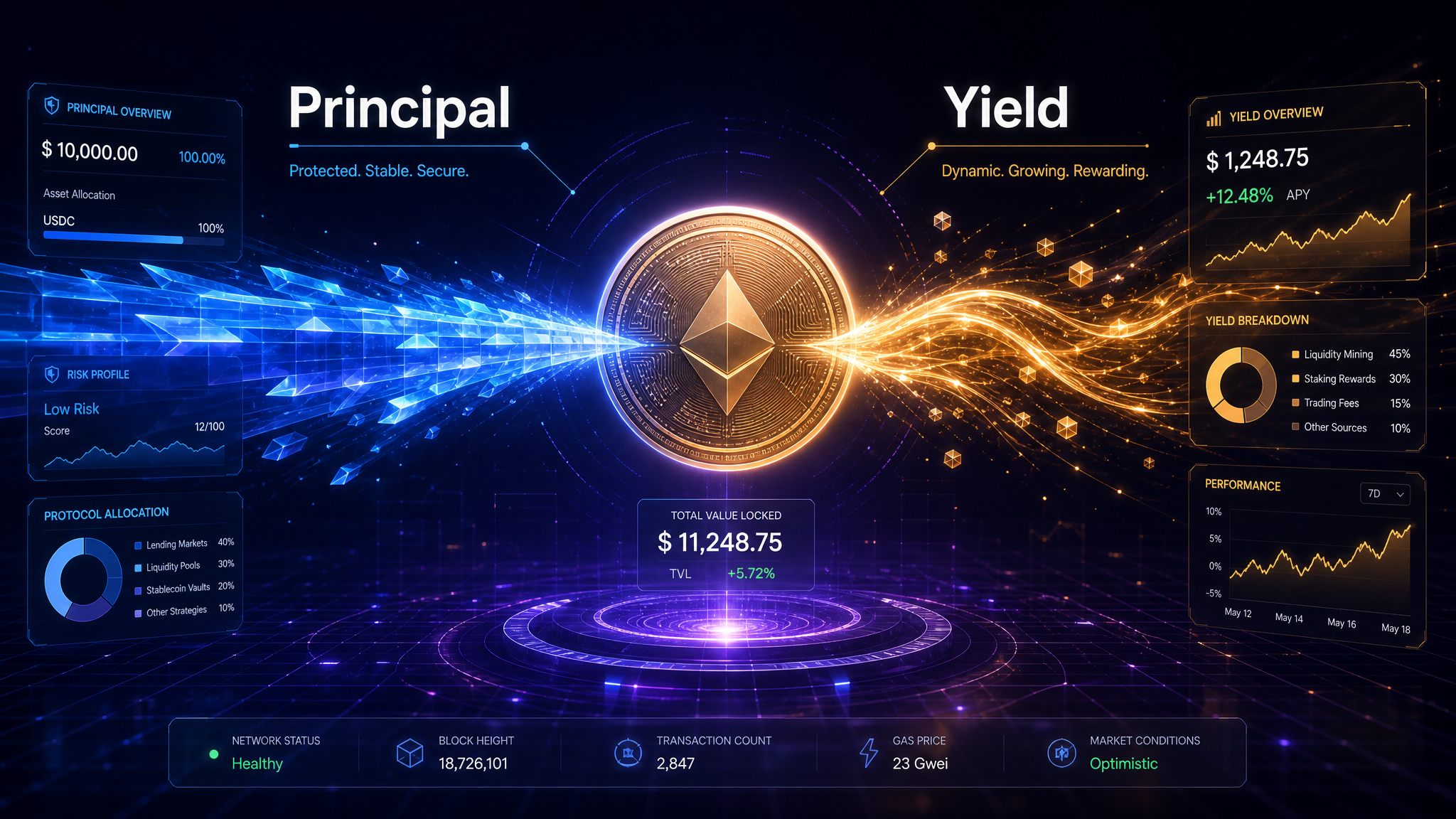
How to Stake Ethereum in 2026: Earn Passive Income on Your ETH
Affiliate Disclosure: This article may contain affiliate links. We may earn a commission at no extra cost to you. All opinions are our own.
Marcus Chen
Senior Crypto Analyst & Educator
Certified Blockchain Professional | Former Wall Street Analyst
Marcus Chen is a cryptocurrency analyst and educator with over 8 years of experience in digital asset trading. He has helped thousands of beginners navigate the crypto markets through practical, actionable education.

About the Author: This guide was written by Marcus Chen, Senior Crypto Analyst & Educator. Marcus Chen brings 8+ years of hands-on experience in cryptocurrency markets, holds the Certified Blockchain Professional designation, and previously worked as a Wall Street Analyst covering digital assets. His analysis has been cited by major crypto publications and he actively manages a diversified crypto portfolio.
Disclaimer: This content is for informational purposes only and should not be considered financial advice. Cryptocurrency investments carry significant risk. Always do your own research (DYOR) before making any investment decisions.
This article contains affiliate links. We may earn a commission at no extra cost to you if you make a purchase through these links. See our affiliate disclosure for details.
How to Stake Ethereum in 2026: Earn Passive Income on Your ETH
If you're holding ETH and watching it sit idle in a wallet, you're leaving money on the table. Learning how to stake Ethereum is one of the most straightforward ways to put your crypto to work — earning between 2.5% and 5% APY while simultaneously helping secure the network. As of early 2026, over 35.6 million ETH (roughly 29% of total supply) is already staked. The question isn't whether staking is worth it. It's which method fits your situation.
This guide breaks down every staking option available in 2026, walks you through a step-by-step Lido tutorial, and covers the risks you need to understand before locking up a single wei.
What Is Ethereum Staking and Why It Matters
Since "The Merge" in September 2022, Ethereum runs entirely on Proof-of-Stake (PoS). Instead of miners burning electricity to validate transactions, validators lock up ETH as collateral. They propose and attest to new blocks, and in return, the network pays them in freshly issued ETH plus a cut of transaction fees.
Why does this matter to you as a regular holder? Because you don't need to run a validator yourself to earn those rewards. Liquid staking protocols and exchanges have made it possible to stake any amount — even $50 worth of ETH — and start earning within minutes.
The numbers are real. At a 3% APY on 10 ETH (roughly $19,000 at current prices), you'd earn about 0.3 ETH per year — approximately $570 — just for participating. Compound that over several years and the math gets interesting fast.
How to Stake Ethereum: 4 Methods Compared
Not all staking is created equal. Your best option depends on how much ETH you hold, your technical comfort level, and how much liquidity you need.
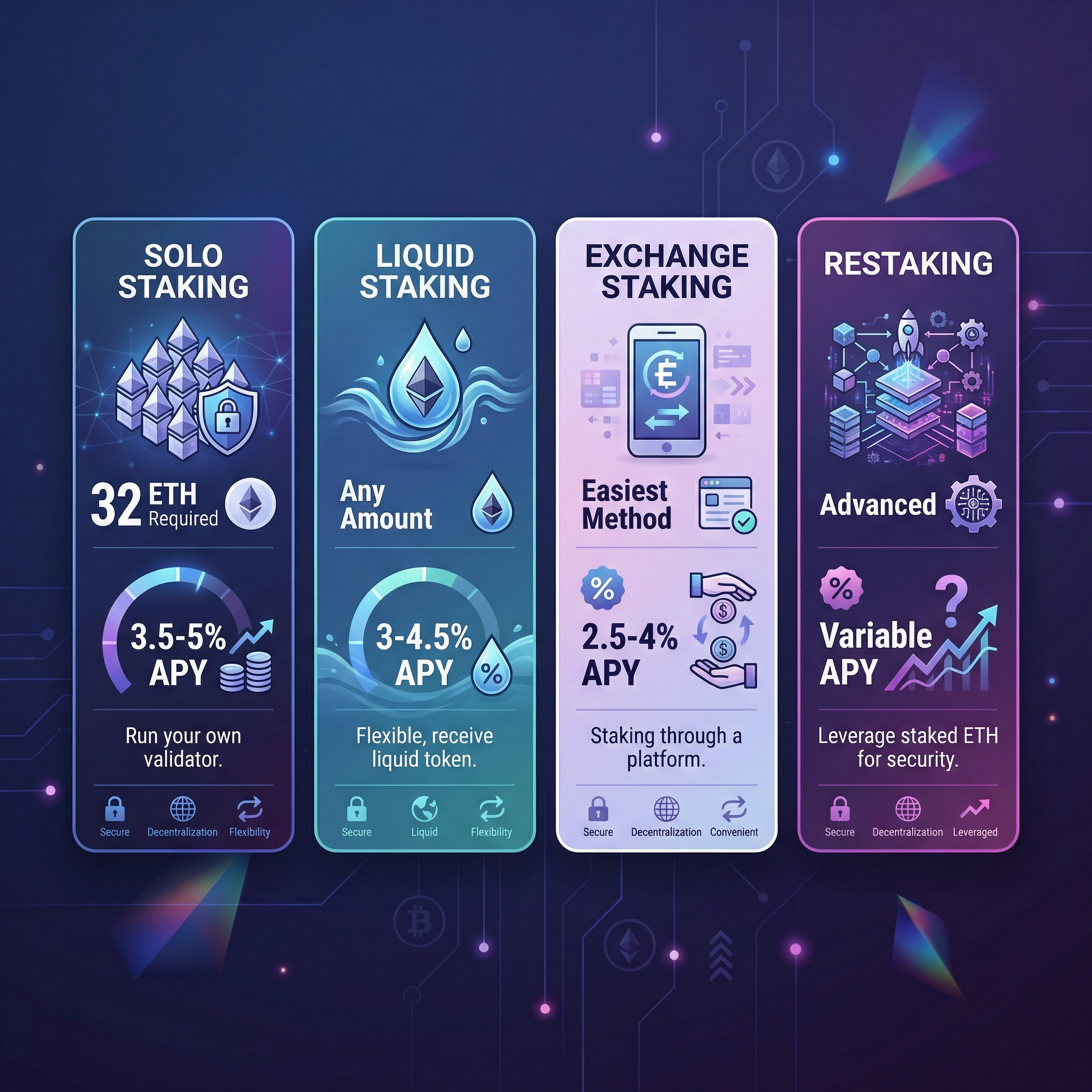 Method 1: Solo Staking (32 ETH Required)
Solo staking means running your own validator node. You deposit exactly 32 ETH into Ethereum's deposit contract, set up dedicated hardware, and keep it online 24/7. The upside: you earn the highest raw yield (3.5–5% APY) with no middleman taking a cut.
The downside is obvious — 32 ETH is roughly $60,000+ at current prices. You also need a machine running continuously, a stable internet connection, and enough technical knowledge to handle client software, updates, and the occasional hiccup. One extended outage can trigger small penalties. A serious misbehavior (like double-signing) triggers slashing, where you lose a portion of your stake.
Solo staking is the gold standard for decentralization, but it's not for everyone. If you have the ETH and the technical chops, it's worth exploring the Ethereum Foundation's official staking launchpad.
Method 2: Liquid Staking with Lido or Rocket Pool
Liquid staking is where most retail stakers land, and for good reason. You deposit any amount of ETH into a protocol like Lido or Rocket Pool, and you receive a derivative token in return — stETH from Lido, rETH from Rocket Pool. That token represents your staked ETH plus accruing rewards.
Here's the clever part: you can use those derivative tokens in DeFi. Deposit stETH into Aave as collateral, add it to a Curve liquidity pool, or use it as a base for restaking. Your ETH is working in multiple places simultaneously.
Lido charges a 10% fee on rewards (so if the base rate is 3.5%, you net about 3.15%). Rocket Pool charges around 15% but is more decentralized — anyone can run a minipool with just 8 ETH. Both are battle-tested protocols with billions in TVL.
Method 3: Exchange Staking (Easiest Option)
Coinbase, Kraken, Binance — most major exchanges offer one-click ETH staking. You don't need a wallet, don't need to understand smart contracts, and can often unstake within a day or two. The tradeoff is fees: exchanges typically take 10–25% of your rewards, leaving you with 2.5–4% APY.
There's also the custody issue. When you stake on an exchange, you don't control your private keys. If the exchange gets hacked, freezes withdrawals, or goes bankrupt (it's happened before), your staked ETH is at risk. For small amounts or beginners just getting started, exchange staking is fine. For larger holdings, consider moving to self-custody options.
Method 4: Restaking via EigenLayer
Restaking is the newest and most complex option. EigenLayer lets you take your already-staked ETH (or liquid staking derivatives like stETH) and re-pledge it to secure additional protocols — called Actively Validated Services (AVS). You earn extra yield on top of your base staking rewards.
The catch: you're stacking risk. If an AVS you're securing gets slashed, your restaked ETH can be penalized. The technology is still maturing. Unless you're comfortable with DeFi complexity and actively monitoring your positions, restaking is best left for later.
Step-by-Step: How to Stake ETH with Lido
Lido is the largest liquid staking protocol with over $20 billion in TVL. Here's exactly how to get started:
- Set up a Web3 wallet. MetaMask is the most widely used option. Download it from metamask.io, create a new wallet, and write down your 12-word seed phrase on paper — never digitally.
- Buy ETH and transfer it to your wallet. Purchase ETH on Coinbase, Kraken, or any major exchange, then withdraw it to your MetaMask address. Double-check the address before confirming.
- Visit stake.lido.fi. Go directly to the official URL. Bookmark it. Phishing sites mimicking Lido are common.
- Connect your wallet. Click "Connect Wallet" and select MetaMask. Approve the connection request in the MetaMask popup.
- Enter the amount of ETH to stake. You can stake as little as 0.01 ETH. Keep a small amount of ETH unstaked to cover gas fees for future transactions.
- Click "Stake" and confirm the transaction. MetaMask will show you the gas fee estimate. Confirm the transaction. During periods of high network activity, gas fees can be $5–$20.
- Receive stETH. Within minutes, your wallet will show stETH. This token automatically accrues staking rewards daily — your stETH balance increases over time without any action on your part.
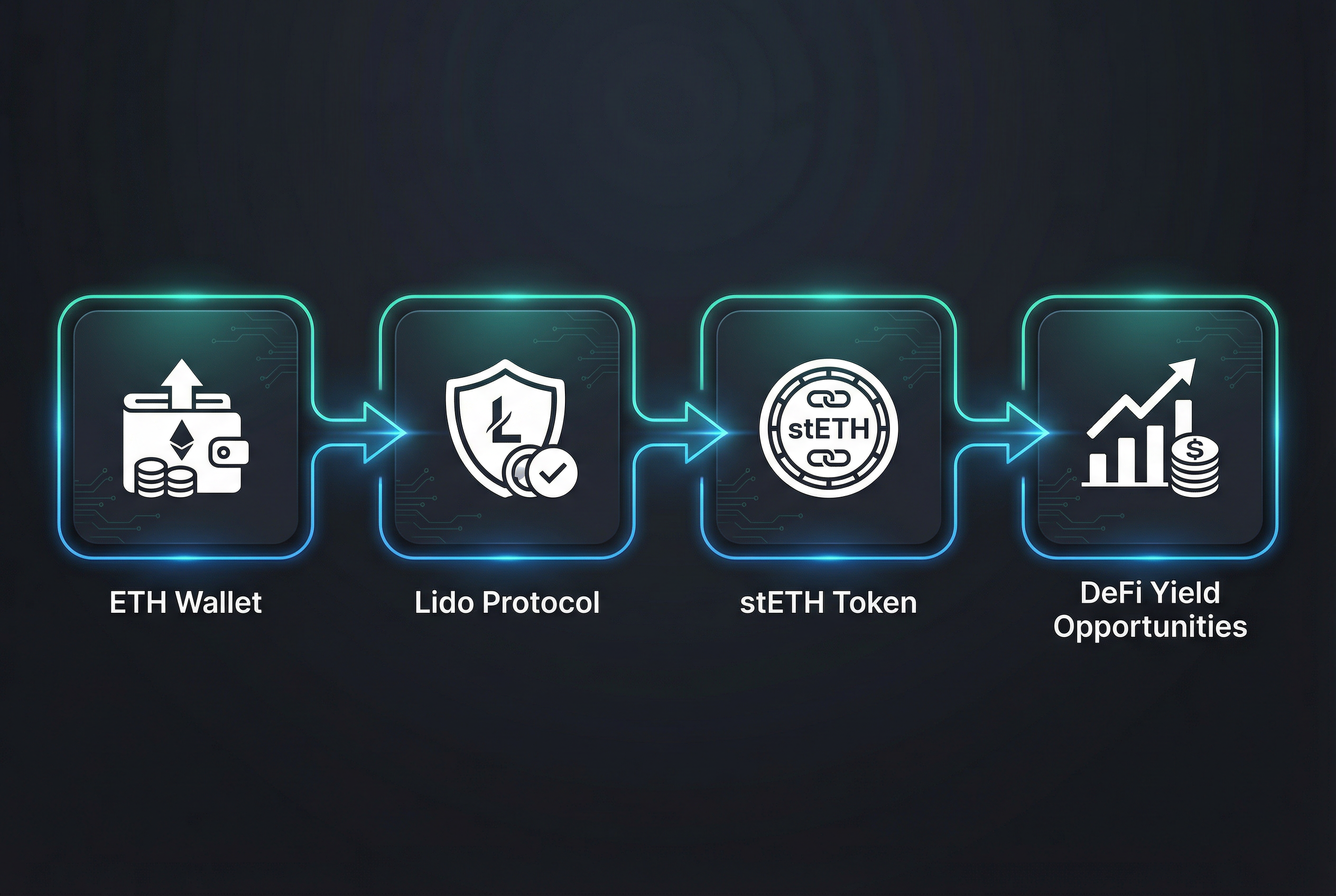 That's it. You're now earning Ethereum staking rewards. To unstake, you can either swap stETH back to ETH on a DEX like Curve, or use Lido's withdrawal function (which involves a queue that can take hours to days depending on network conditions).
Ethereum Staking Rewards: What to Realistically Expect
Let's talk numbers without the hype. The current network-wide staking yield sits around 2.9–3.1% APR. After protocol fees, liquid stakers typically net 2.7–3.5% depending on the platform. Solo stakers can push toward 4–5% in favorable conditions.
A few scenarios to illustrate:
- 1 ETH staked via Lido at 3.2% APY: ~0.032 ETH earned per year (~$61 at $1,900/ETH)
- 5 ETH staked via Rocket Pool at 3.0% APY: ~0.15 ETH per year (~$285)
- 32 ETH solo staked at 4.5% APY: ~1.44 ETH per year (~$2,736)
These are staking rewards only — they don't account for ETH price appreciation or depreciation. If ETH doubles in price, your rewards are worth twice as much. If it drops 50%, so does the dollar value of your yield. Staking doesn't protect you from price risk.
One more thing: staking rewards are generally taxable as ordinary income in the US in the year they're received. Keep records. Tools like Koinly or CoinTracker can automate this.
Ready to master crypto trading alongside your staking strategy? Want to accelerate your trading journey? Explore Icoinpro's daily trading signals and education platform.
Risks You Need to Know Before Staking ETH
Staking isn't risk-free. Here's what can go wrong:
- Slashing: Validators that misbehave (double-signing, extended downtime) lose a portion of their staked ETH. This primarily affects solo stakers and SaaS users, not liquid stakers.
- Smart contract risk: Lido, Rocket Pool, and EigenLayer are all smart contract systems. A bug or exploit could drain funds. Both Lido and Rocket Pool have been audited extensively, but no code is 100% bulletproof.
- Derivative depegging: stETH and rETH can trade below ETH's price during market stress. In May 2022, stETH briefly traded at a 5% discount. If you need to exit quickly during a crash, you might sell at a loss.
- Liquidity constraints: Ethereum's exit queue can stretch to weeks during high-demand periods. Plan accordingly — don't stake ETH you might need urgently.
- Centralization risk: Lido controls roughly 28% of all staked ETH. That concentration is a systemic concern for Ethereum's decentralization, though it doesn't directly harm individual stakers.
None of these risks are reasons to avoid staking entirely. They're reasons to size your position appropriately and choose your method carefully.
Securing Your Staked ETH: Hardware Wallet Best Practices
Whether you're staking via Lido or running a solo validator, the security of your wallet is paramount. A compromised seed phrase means losing everything — staked ETH included.
For holdings above $1,000, a hardware wallet is non-negotiable. These devices store your private keys offline, meaning even if your computer is infected with malware, an attacker can't sign transactions without physical access to the device.
Protect your crypto assets with a Ledger hardware wallet — the gold standard in cold storage security.
If you prefer an alternative with a touchscreen interface, The Trezor Model T offers top-tier security with an intuitive touchscreen interface.
When connecting a hardware wallet to MetaMask for Lido staking, generate a fresh seed phrase on the hardware device itself — never import an existing software wallet seed into hardware. Every transaction you sign through MetaMask will require physical confirmation on the device, adding a critical layer of protection.
Store your recovery phrase on paper (or a metal backup like Cryptosteel) in a secure location. Never photograph it, type it into any website, or store it in cloud services. This single piece of information is the master key to your entire crypto portfolio.
Key Takeaways
- Ethereum staking lets you earn 2.5–5% APY by helping secure the network — no mining required.
- Liquid staking (Lido, Rocket Pool) is the best balance of accessibility and yield for most holders.
- Exchange staking is easiest but comes with custody risk and higher fees.
- Solo staking offers the highest rewards but requires 32 ETH and technical expertise.
- Staking rewards are taxable income in most jurisdictions — keep records from day one.
- Always secure your wallet with a hardware device for holdings above $1,000.
- Risks include smart contract bugs, derivative depegging, and liquidity constraints — size your position accordingly.
{ "@context": "https://schema.org", "@type": "Article", "headline": "How to Stake Ethereum in 2026: Earn Passive Income on Your ETH", "description": "Learn how to stake Ethereum in 2026 and earn 2.5–5% APY. Compare solo staking, liquid staking with Lido, and exchange staking options.", "author": { "@type": "Person", "name": "Marcus Chen", "jobTitle": "Senior Crypto Analyst & Educator" }, "datePublished": "2026-04-02", "dateModified": "2026-04-02", "image": [ "https://cdn.abacus.ai/images/a0555872-f292-40d5-9a03-b2ae87cac0e4.png", "https://cdn.abacus.ai/images/6a294449-bb39-41ed-b34d-4cb249b74a8f.png", "https://cdn.abacus.ai/images/874f452a-31fa-4946-82b9-d6063b6578c8.png" ], "articleSection": "DeFi & Web3", "keywords": "how to stake Ethereum, Ethereum staking 2026, stake ETH passive income, liquid staking ETH, Lido staking guide" }
June 2026 Update: Ethereum Staking Yields and New Developments
Ethereum staking has matured significantly since this article was first published. Here's what's changed and what it means for your staking strategy.
Current Staking Yields (June 2026)
As of late June 2026, approximately 32% of the total ETH supply is staked — roughly 39.7 million ETH. This high participation rate has compressed base consensus yields to approximately 2.7%–2.8% annually. However, validators using MEV-Boost to capture priority fees typically see all-in yields of 3.1%–3.8%. The entry queue has surged to 50–62 days due to institutional demand, while the exit queue remains near zero — a strong signal that current stakers are committed.
Post-Pectra Upgrade Changes
The Pectra upgrade (May 2025) fundamentally changed how staking works. EIP-7251 increased the maximum effective balance per validator from 32 ETH to 2,048 ETH, allowing institutional operators to consolidate validators. EIP-7002 enabled execution-layer-triggered exits, making delegated staking safer. EIP-6110 moved validator deposits on-chain, reducing activation times. If you're using a liquid staking protocol, these changes have already been implemented behind the scenes.
Lido's Market Share Decline
Lido's dominance has declined from its 2023 peak to approximately 23% of total staked ETH — a healthier, more decentralized distribution. Rocket Pool, Frax ETH, and institutional operators have all gained ground. For most retail stakers, liquid staking via Lido or Rocket Pool remains the most practical option, offering daily liquidity without the 32 ETH minimum or 50–62 day activation wait.
Frequently Asked Questions
What is the current Ethereum staking APR in 2026?
Base consensus yields are approximately 2.7%–2.8% as of June 2026. With MEV-Boost rewards, all-in yields typically range from 3.1% to 3.8% annually. Liquid staking protocols like Lido offer slightly lower yields due to their 10% protocol fee.
How long does it take to activate a new Ethereum validator in 2026?
Due to high institutional demand, the entry queue has surged to approximately 50–62 days as of mid-June 2026. If you need faster access to staking rewards, liquid staking protocols like Lido or Rocket Pool offer immediate participation without the queue.
Is Ethereum staking still worth it in a bear market?
Staking rewards are denominated in ETH, so you accumulate more ETH regardless of price. If you're a long-term ETH holder, staking is almost always worth it — you're earning yield on assets you'd hold anyway. The risk is ETH price volatility, not the staking mechanism itself.
What are the risks of restaking through EigenLayer?
Restaking through EigenLayer offers additional yield (typically under 1%), but introduces layered risks: smart contract vulnerabilities, shared slashing conditions across multiple Actively Validated Services (AVSs), and liquidity risk on restaked positions. Only restake what you can afford to have locked up for extended periods.
Should I use a hardware wallet for staking?
For solo staking (32 ETH), yes — a hardware wallet like the Ledger Nano X protects your withdrawal credentials. For liquid staking protocols, your stETH or rETH tokens should also be stored in cold storage for maximum security.
Article last updated: 2026-06-29. Related reading: MiCA Regulation Crypto 2026 | How to Use EigenLayer Restaking in 2026 | Best Crypto Staking Platforms 2026
DeFi moves fast. Your trading skills need to keep up.
Whether you're yield farming or trading tokens, the fundamentals of reading charts, managing risk, and timing entries apply everywhere in crypto. Those skills are worth developing properly.
The program I recommend to people who ask me is this crypto trading course — it\'s the one I point friends and family to when they\'re serious about learning. Daily lessons, live analysis, and a community that actually helps.
Affiliate link — I may earn a commission at no extra cost to you. I only recommend what I genuinely use.
Disclaimer: The information provided on this website is for educational and informational purposes only. It should not be considered financial or investment advice. Cryptocurrency investments carry significant risk. Always do your own research and consult with a qualified financial advisor before making investment decisions.
Free Crypto Insights
Get weekly trading tips, market analysis, and exclusive strategies delivered to your inbox.