DeFi Yield Looping in 2026: How to Double Your ETH Staking Returns (And Survive the Risks)
Affiliate Disclosure: This article may contain affiliate links. We may earn a commission at no extra cost to you. All opinions are our own.
Marcus Chen
Senior Crypto Analyst & Educator
Certified Blockchain Professional | Former Wall Street Analyst
Marcus Chen is a cryptocurrency analyst and educator with over 8 years of experience in digital asset trading. He has helped thousands of beginners navigate the crypto markets through practical, actionable education.

Disclaimer: This content is for informational purposes only and should not be considered financial advice. Cryptocurrency investments carry significant risk. Always do your own research (DYOR) before making any investment decisions.
This article contains affiliate links. We may earn a commission at no extra cost to you if you make a purchase through these links. See our affiliate disclosure for details.
DeFi Yield Looping in 2026: How to Double Your ETH Staking Returns (And Survive the Risks)
DeFi yield looping is one of the most powerful — and most misunderstood — advanced strategies in crypto right now. The core idea is simple: you deposit staked ETH as collateral, borrow regular ETH against it, swap that borrowed ETH back into staked ETH, and repeat. Each loop amplifies your exposure to the staking yield. Done right, you can turn a 3.5% base staking APY into 8–12% or more. Done wrong, you get liquidated. This guide breaks down exactly how the strategy works in 2026, which platforms to use, and how to manage the risks without blowing up your position.
What Is DeFi Yield Looping?
Yield looping — sometimes called leveraged staking or recursive borrowing — is a strategy that uses lending protocols to amplify returns on yield-bearing assets. The asset most commonly used is wstETH (Lido's wrapped staked ETH), which earns the Ethereum staking yield (~3.2–3.8% APY in late 2026) while also being accepted as collateral on major lending platforms.
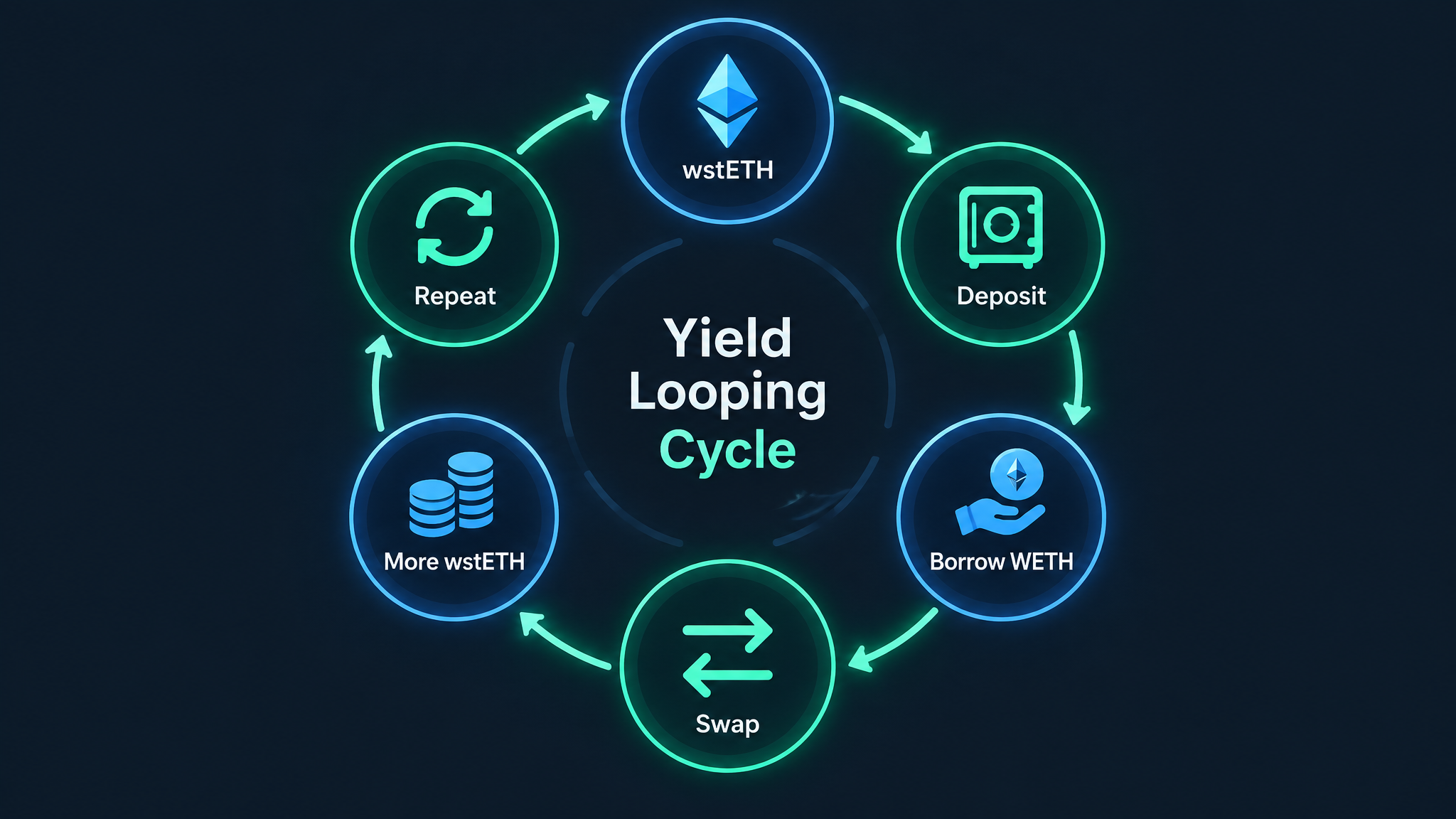
Here's the basic loop cycle:
- Deposit wstETH into a lending protocol (Aave, Morpho, or Fluid)
- Borrow WETH against your wstETH collateral
- Swap the borrowed WETH for more wstETH
- Deposit the new wstETH as additional collateral
- Repeat until you hit your target leverage
The math works because wstETH and WETH are highly correlated — they track each other closely — so lending protocols allow high loan-to-value (LTV) ratios for this pair. On Morpho's wstETH/WETH market, the liquidation LTV sits at 94.5%. On Aave V4 using E-Mode, you can borrow up to 90% LTV. That high LTV is what makes meaningful leverage possible without requiring massive overcollateralization.
The Math: What Returns Can You Actually Expect?
Let's run real numbers. Assume wstETH earns 3.5% APY and WETH borrow costs 1.8% APY on Aave (rates as of November 2026). Your yield spread is 1.7 percentage points.
With an 80% LTV and 4x leverage:
- Total exposure: 4 ETH worth of wstETH (on 1 ETH of initial capital)
- Gross staking yield: 4 × 3.5% = 14%
- Borrow cost: 3 ETH borrowed × 1.8% = 5.4%
- Net APY: ~8.6% on your original 1 ETH
Compare that to simply holding wstETH: 3.5% APY. The loop more than doubles your return. At 5x leverage (90% LTV), net APY climbs to roughly 10.7%. Beyond 5–6x, the marginal gain shrinks while liquidation risk spikes — most experienced DeFi traders cap out at 3x–4x for a reason.
One important nuance: borrow rates on Aave and Morpho are variable. If WETH utilization spikes during a market panic, borrow costs can jump from 1.8% to 8% or higher overnight. That can flip your spread negative and turn a profitable loop into a slow bleed. More on managing that below.
Which Platforms to Use in 2026
Three protocols dominate wstETH looping in 2026, each with different tradeoffs:
Aave V4
Aave's V4 "hub-and-spoke" architecture isolates collateral assets into dedicated spokes, reducing systemic risk. For wstETH/WETH looping, Aave's E-Mode (Efficiency Mode) allows up to 90% LTV — significantly higher than standard markets. Aave has the deepest liquidity of any lending protocol, which matters when you need to unwind a large position quickly. The downside: because it's a shared pool, a bad debt event in an unrelated market can theoretically affect your position (though V4's isolation mitigates this considerably).
Morpho
Morpho runs isolated peer-to-peer markets. The wstETH/WETH market on Morpho currently offers a 94.5% liquidation LTV — the highest available for this pair. Because each market is isolated, you're not exposed to risks from other collateral types. Morpho is the go-to for users who want maximum capital efficiency and are comfortable with a slightly less liquid exit. As of November 2026, Morpho's wstETH/WETH market has over $2.1 billion in TVL.
Fluid
Fluid (formerly Instadapp) offers vaults with LTVs up to 95% and a sophisticated liquidation engine designed to minimize bad debt. It's newer and has less battle-testing than Aave or Morpho, but the higher LTV ceiling attracts aggressive yield seekers. Verify vault-specific parameters before committing capital here.
For most users, Aave V4 is the safest starting point due to its liquidity depth and track record. Morpho is the choice for experienced DeFi users who want to push leverage higher with isolated risk.
How to Execute the Loop: Step-by-Step
You have two options: manual looping or one-click automation.
Manual Looping
- Acquire wstETH (wrap stETH via Lido, or buy directly on Uniswap)
- Connect to Aave V4 or Morpho and supply wstETH as collateral
- Borrow WETH at your target LTV (start conservative — 70% max for your first loop)
- Swap borrowed WETH → wstETH on a DEX aggregator (1inch or Paraswap for best rates)
- Deposit the new wstETH back as collateral
- Repeat 2–4 more times until you reach target leverage
- Monitor your health factor daily
One-Click Automation
Platforms like Gearbox Protocol (Ethereum) and Kamino Finance (Solana) bundle the entire loop into a single atomic flash loan transaction. You specify your target leverage, and the protocol handles all the recursive steps in one on-chain call. This saves gas and eliminates execution risk between steps. Gearbox also lets you layer additional yield sources on top — for example, depositing your looped position into a Balancer pool to earn swap fees on top of staking yield.
Risk Management: The Part Most Guides Skip
Yield looping is not a set-and-forget strategy. Three risks can destroy your position:
1. Liquidation Risk
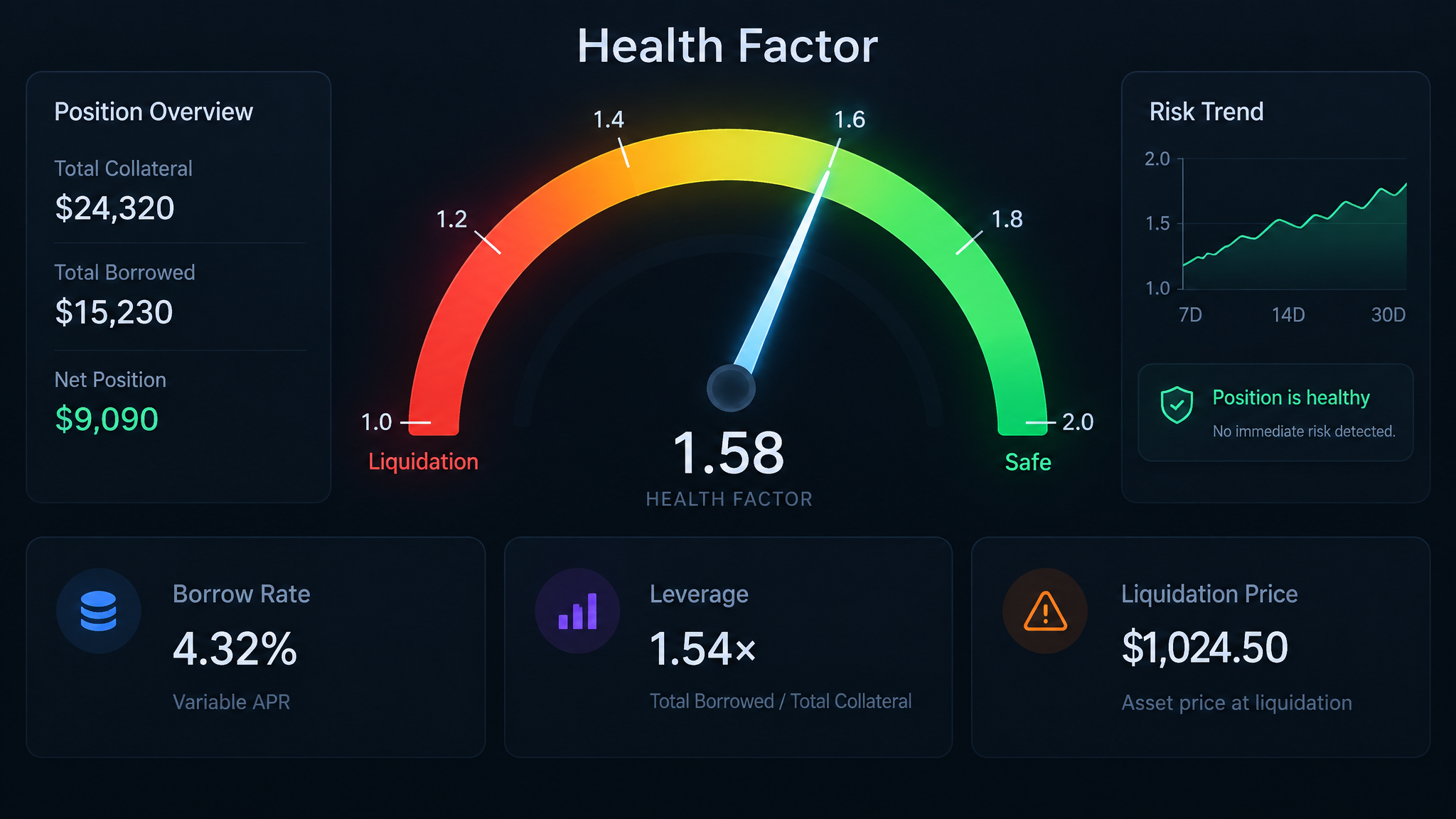
At 4x leverage with 80% LTV, your liquidation price is roughly 5–8% below your entry (depending on the protocol's liquidation threshold). A sudden wstETH depeg — like the brief 2% depeg seen during the March 2026 oracle incident — can push your health factor dangerously close to 1.0. Set health factor alerts at 1.25 and 1.15. When you hit 1.25, consider partially unwinding. At 1.15, unwind aggressively.
2. Borrow Rate Spikes
WETH borrow rates on Aave are algorithmically determined by utilization. During the November 2026 Bitcoin selloff, WETH utilization briefly hit 95%, pushing borrow rates above 12% APY. At that rate, a 4x loop with 3.5% staking yield is deeply negative. Use Loopscale or similar fixed-rate lending protocols if you want to lock in your borrow cost and eliminate this variable entirely.
3. Exit Liquidity Risk
Unwinding a large loop during market stress is harder than it looks. DEX liquidity thins out, slippage increases, and Lido's native withdrawal queue can take weeks during high-demand periods. Always test your exit with a small position first. Know your slippage tolerance before you scale up.
Conservative baseline: 3x–4x leverage, health factor target above 1.4, borrow rate alerts set at 5% APY. This gives you meaningful yield amplification while keeping liquidation risk manageable.
Tax Considerations
In the US, borrowing against your wstETH is generally not a taxable event — you're not selling. However, swapping WETH to wstETH during each loop iteration is a taxable swap. If you're doing this in a high-frequency automated setup, those swaps add up fast. Track every transaction with a crypto tax tool. The IRS has been increasingly focused on DeFi activity since the 2025 broker reporting rules took effect.
Ready to master crypto trading? Check out Icoinpro's comprehensive trading course — it covers DeFi strategies, risk management, and how to build systematic approaches to yield generation.
Protecting Your Assets While You Loop
When you're running leveraged DeFi positions, keeping your private keys secure is non-negotiable. A compromised wallet can drain your entire looped position in seconds. Protect your crypto assets with a Ledger hardware wallet — the gold standard in cold storage security. Use a hardware wallet for your primary holdings and only bridge what you need to an active hot wallet for DeFi interactions.
Is Yield Looping Right for You?
This strategy is genuinely powerful, but it's not for everyone. You need to be comfortable monitoring positions daily, understand how health factors work, and have a clear exit plan before you enter. If you're still learning the basics of DeFi, start with simple staking or a yield aggregator like Yearn before adding leverage.
For experienced DeFi users who already hold wstETH and understand liquidation mechanics, looping is one of the highest risk-adjusted yield strategies available in 2026. The 8–12% APY range is real — and it's denominated in ETH, not a volatile governance token.
For a deep dive into Bitcoin's monetary philosophy and why ETH staking fits into a broader crypto wealth strategy, grab a copy of The Bitcoin Standard.
Key Takeaways
- DeFi yield looping amplifies wstETH staking returns from ~3.5% to 8–12%+ APY through recursive borrowing
- Aave V4 (90% LTV E-Mode) and Morpho (94.5% LLTV) are the top platforms for wstETH/WETH loops in 2026
- 3x–4x leverage is the sweet spot — meaningful yield amplification without excessive liquidation risk
- Monitor health factor daily; set alerts at 1.25 and 1.15; have a clear exit plan before entering
- Variable borrow rates are the hidden risk — consider fixed-rate protocols like Loopscale to lock in your spread
- Each WETH→wstETH swap during looping is a taxable event in the US — track everything
DeFi moves fast. Your trading skills need to keep up.
Whether you're yield farming or trading tokens, the fundamentals of reading charts, managing risk, and timing entries apply everywhere in crypto. Those skills are worth developing properly.
The program I recommend to people who ask me is this crypto trading course — it\'s the one I point friends and family to when they\'re serious about learning. Daily lessons, live analysis, and a community that actually helps.
Affiliate link — I may earn a commission at no extra cost to you. I only recommend what I genuinely use.
Disclaimer: The information provided on this website is for educational and informational purposes only. It should not be considered financial or investment advice. Cryptocurrency investments carry significant risk. Always do your own research and consult with a qualified financial advisor before making investment decisions.
Free Crypto Insights
Get weekly trading tips, market analysis, and exclusive strategies delivered to your inbox.