How to Earn Yield on Stablecoins in 2026: A DeFi Strategy Guide
Affiliate Disclosure: This article may contain affiliate links. We may earn a commission at no extra cost to you. All opinions are our own.
Marcus Chen
Senior Crypto Analyst & Educator
Certified Blockchain Professional | Former Wall Street Analyst
Marcus Chen is a cryptocurrency analyst and educator with over 8 years of experience in digital asset trading. He has helped thousands of beginners navigate the crypto markets through practical, actionable education.
How to Earn Yield on Stablecoins in 2026: A DeFi Strategy Guide
If you're holding USDC, DAI, or USDT and letting them sit idle, you're leaving money on the table. Learning how to earn yield on stablecoins has become one of the most practical skills in crypto — and in 2026, the landscape looks very different from just a year ago. Regulatory shifts, new DeFi protocols, and a $309 billion stablecoin market mean the opportunities are real, but so are the risks. This guide walks you through the strategies, the steps, and the due diligence you need to do it right.
What Is Stablecoin Yield and Why It Matters in 2026
Stablecoins are pegged to fiat currencies — usually the US dollar — which makes them a unique asset class. They don't appreciate like Bitcoin, but they also don't crash 40% overnight. That stability is exactly what makes them useful as a base for yield strategies.
Yield on stablecoins comes from putting those assets to work: lending them to borrowers, providing liquidity to trading pools, or depositing them into automated vaults. Returns vary widely — from 3–5% APY on conservative strategies to 15%+ on riskier plays — but the key is understanding where the yield comes from before you commit capital.
The Regulatory Landscape: What the CLARITY Act Means for You
The Digital Asset Market Clarity (CLARITY) Act is reshaping stablecoin yield in 2026. After passing the House in July 2025, the bill stalled in the Senate over one contentious issue: yield. The latest draft explicitly bans offering yield for simply holding stablecoins on centralized platforms — exchanges, brokers, and affiliated entities. Traditional banks lobbied hard for this, and it shows. Standard Chartered estimated that permissive yield rules could redirect up to $500 billion in deposits from banks to stablecoin products by 2028.
What does this mean practically? If the CLARITY Act passes as written, earning passive interest on stablecoins through Coinbase or similar platforms ends. The focus shifts entirely to DeFi — where yield comes from active participation, not passive holding. A Senate Banking Committee markup is targeted for late April 2026. DeFi protocols like Aave and Uniswap are not covered by the same restrictions, which is actually pushing more capital toward on-chain strategies.
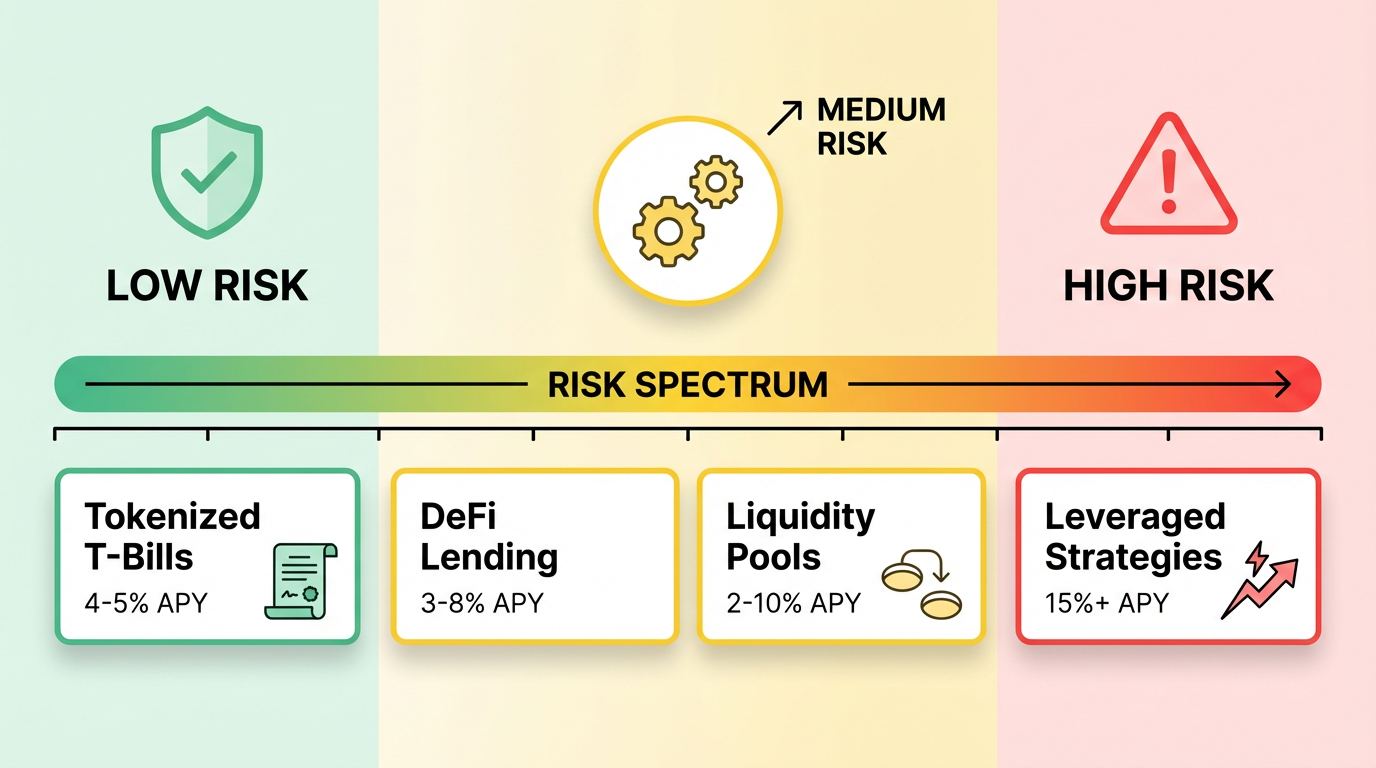
Stablecoin Yield Strategies: From Low Risk to High Risk
Low-Risk: Tokenized Treasury Bills and Protocol Savings Rates
The safest option is tokenized US Treasury bills. Products like USYC represent on-chain interests in funds holding short-term government debt, offering T-bill yields currently in the 4–5% range. The risk is minimal — you're essentially exposed to US government credit risk. Some stablecoin protocols also offer native savings modules, like the Sky Savings Rate for USDS, though these carry smart contract and governance risk.
Medium-Risk: DeFi Lending on Aave and Compound
This is the bread-and-butter of stablecoin yield. Supply USDC or DAI to a lending protocol, and borrowers pay you interest to use those funds. Aave and Compound are the two dominant platforms, with billions in total value locked. APYs fluctuate with market demand — typically 3–8% for stablecoins, spiking higher during bull markets when leverage demand increases. You receive interest-bearing tokens (aUSDC on Aave) that accrue yield in real time.
Ready to master crypto trading alongside your yield strategies? Icoinpro offers step-by-step training that has helped thousands of beginners build a complete crypto skill set.
Medium-Risk: Liquidity Provision on DEXs
Providing liquidity to stablecoin pairs on Uniswap earns you a share of trading fees. Stablecoin-to-stablecoin pools (USDC/DAI, USDC/USDT) are attractive because impermanent loss is minimal when both assets maintain their peg. On Uniswap v3, you can concentrate liquidity within a tight price range to earn more fees per dollar deployed. Reported APYs on stablecoin pairs typically range from 2–10%, depending on trading volume.
High-Risk: Leveraged Strategies
"Looping" involves supplying stablecoins to Aave, borrowing against them, and redeploying the borrowed funds to earn more yield. Done carefully with conservative loan-to-value ratios, this can boost effective APY. Done recklessly, a spike in borrow rates can trigger liquidation. These strategies are for advanced users only.
Step-by-Step: How to Start Earning Yield on Stablecoins
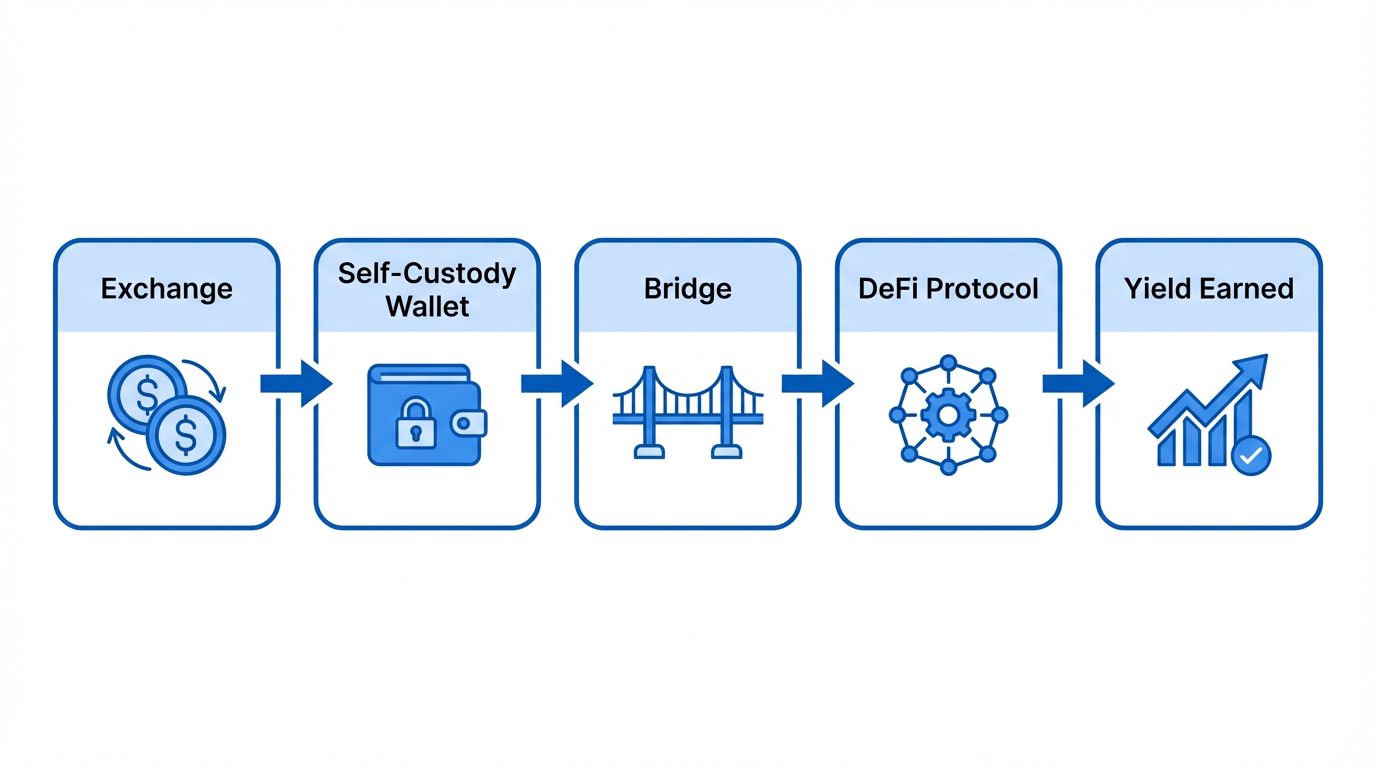
Step 1 – Set Up a Self-Custody Wallet
DeFi requires a non-custodial wallet — one where you control the private keys. MetaMask is the most widely supported option. Download it as a browser extension, create a new wallet, and write down your 12-word seed phrase on paper. Store it offline. This seed phrase is the master key to your funds — losing it means losing everything. Rabby Wallet is another excellent option with better transaction simulation features.
Step 2 – Acquire and Bridge Your Stablecoins
Buy USDC or DAI on a centralized exchange (Coinbase, Kraken, Binance). Then decide which blockchain to use. Ethereum mainnet has the deepest liquidity but higher gas fees. Layer 2 networks like Arbitrum or Base offer the same protocols at a fraction of the cost — often under $0.10 per transaction. To move stablecoins from Ethereum to Arbitrum, use a reputable bridge like Stargate Finance or the official Arbitrum Bridge. Always do a small test transaction first. Make sure you have ETH on both chains to pay gas fees.
Step 3 – Supply Stablecoins to Aave
Navigate to app.aave.com and connect your wallet. Select your network (Arbitrum, Base, or Ethereum mainnet). Find USDC in the supply list, click "Supply," enter your amount, approve the transaction, then confirm the supply. You'll receive aUSDC tokens that accrue interest automatically. Withdraw at any time by returning to Aave and clicking "Withdraw."
Protect your crypto assets with a Ledger hardware wallet — the gold standard in cold storage security. When managing meaningful DeFi positions, keeping your private keys on a hardware device is non-negotiable.
Risk Management: The Due Diligence Checklist
Chasing high APYs without understanding the risks is the fastest way to lose money in DeFi. Before deploying capital into any yield strategy, work through this checklist:
- Source of yield: Is it from real economic activity (borrower interest, trading fees) or inflationary token incentives? Sustainable yield comes from the former.
- Smart contract risk: Has the protocol been audited by reputable firms? How long has it been running without incidents?
- Depeg risk: What happens to your position if the stablecoin loses its peg? USDC and DAI have strong track records, but no stablecoin is immune.
- Liquidity and exit: Can you withdraw quickly if needed? Some protocols have withdrawal queues during stress events.
- Diversification: Spread across Aave, Compound, and a tokenized Treasury product to reduce single-point-of-failure risk.
Tax Implications for Stablecoin Yield in 2026
Yield earned on stablecoins is taxable income in the US. The IRS treats lending interest and liquidity mining income as ordinary income, valued at fair market price when received. New for the 2025 tax year: centralized exchanges will issue Form 1099-DA reporting gross proceeds from digital asset sales. The IRS also now requires wallet-by-wallet cost basis tracking, making record-keeping more complex for active DeFi users.
Use specialized crypto tax software to stay compliant. Platforms like CoinLedger, Koinly, and Awaken connect to your wallets via API, automatically categorize DeFi transactions, and generate the forms you need. Want to understand the deeper economics behind the assets you're earning yield on? The Bitcoin Standard is essential reading for every crypto enthusiast who wants to understand monetary theory alongside practical strategy.
Final Thoughts and Actionable Takeaways
Stablecoin yield in 2026 is a genuine opportunity — but it requires active engagement, not passive hoping. The CLARITY Act is pushing the action firmly into DeFi, which means the tools and protocols you use matter more than ever. Here's what to take away:
- Start conservative: Tokenized Treasury bills or Aave lending are the right entry points. Get comfortable with the mechanics before exploring higher-risk strategies.
- Use Layer 2 networks: Arbitrum and Base offer the same DeFi protocols as Ethereum mainnet at a fraction of the gas cost.
- Understand your yield source: If you can't explain where the yield comes from, don't deploy capital.
- Secure your wallet: A hardware wallet is essential for any meaningful DeFi position.
- Track your taxes: Use crypto tax software from day one. Retroactively reconstructing DeFi transaction history is painful and expensive.
- Stay informed on regulation: The CLARITY Act markup is expected in late April 2026. Changes could affect which strategies remain viable on centralized platforms.
Updated: May 2026 Stablecoin Yield Rates
Stablecoin yields have stabilized in 2026 following the passage of the GENIUS Act, which clarified that stablecoin issuers cannot pay yield directly to holders — but third-party DeFi protocols can. Here's where rates stand as of May 2026:
- Aave V3: USDC 3.5–6.5% APY, USDT 4.0–7.5% APY (variable, utilization-dependent)
- Morpho Blue: USDC 4.0–8.0% APY, USDT 4.5–9.0% APY via curator-managed vaults
- Compound V3: USDC 3.5–6.0% APY
- Curve Finance: Stablecoin pairs 2–8% APY from trading fees
- Yield-bearing stablecoins (sDAI, USDG): 4.5–8.0% APY built into the token
The GENIUS Act has actually clarified the landscape — yield from DeFi protocols remains fully accessible, and the regulatory certainty has attracted more institutional capital into stablecoin lending markets.
Frequently Asked Questions
What is the best stablecoin yield platform in 2026?
Morpho Blue offers some of the highest yields (4–9% APY) with audited smart contracts. Aave V3 remains the benchmark for safety and liquidity. For beginners, Aave's simplicity and deep liquidity make it the best starting point.
Is stablecoin yield taxable?
Yes, in most jurisdictions stablecoin yield is treated as ordinary income. Track your earnings carefully — crypto tax software like CoinLedger can automate this. Always consult a tax professional for your specific situation.
What happened to stablecoin yields after the GENIUS Act?
The GENIUS Act (2025) prevents stablecoin issuers from paying yield directly to holders. However, DeFi protocol yields remain unaffected — you can still earn 4–9% APY by depositing stablecoins into Aave, Morpho, or Curve. The act actually brought regulatory clarity that stabilized the market.
How much can I realistically earn on $10,000 in stablecoins?
At 5% APY on Aave, $10,000 earns approximately $500 per year. At 7% on Morpho, that's $700. Higher-risk strategies (delta-neutral, vault aggregators) can push 10–15%, but carry smart contract and liquidation risks.
Are DeFi stablecoin yields safe?
No DeFi protocol is risk-free. Smart contract exploits, oracle failures, and liquidity crises are real risks. Stick to audited protocols with long track records (Aave, Compound, Curve), diversify across platforms, and never deposit more than you can afford to lose.
Related Articles
- Best DeFi Yield Farming Platforms in 2026
- How to Use Aave DeFi Lending and Borrowing in 2026
- How to Use EigenLayer Restaking in 2026
Frequently Asked Questions: Stablecoin Yield in 2026
- What are the best stablecoin yield rates in August 2026?
- As of August 2026, reputable DeFi platforms like Aave V3 and Morpho offer 3.5%–9% APY on USDC and USDT. Sky (formerly MakerDAO) provides 4.0%–4.5% via its Sky Savings Rate (SSR). RWA-backed platforms like Ondo Finance offer more stable, Treasury-linked yields in the 4%–6% range.
- Is it safe to earn yield on stablecoins in 2026?
- Safety depends on the platform and yield tier. Tier 1 platforms (Aave, Compound, Sky SSR) carry the lowest risk. Yields above 12% APY typically involve structural risks and should be approached with caution.
- How does the GENIUS Act affect stablecoin yield?
- The GENIUS Act (signed July 2025) prohibits payment stablecoin issuers from paying yield directly to holders. Yield generation now happens through DeFi protocols or third-party vaults. Platforms like Aave and Morpho are unaffected.
- What's the difference between DeFi and CeFi stablecoin yield?
- DeFi yield (Aave, Morpho, Compound) is non-custodial — you retain control via smart contracts. CeFi yield (Coinbase, Kraken, Nexo) is custodial. DeFi eliminates counterparty risk but requires more technical knowledge.
- Can I earn stablecoin yield across multiple chains?
- Yes. In 2026, cross-chain yield management is standard. Tools like Eco Routes let you move liquidity between Ethereum, Base, and Arbitrum to capture the best rates. Morpho and Aave both operate on multiple chains.
For more on navigating DeFi, see our guides on how to use Aave for lending and borrowing and how the CLARITY Act delay affects DeFi regulation in 2026.
Updated August 2026: This guide has been refreshed with current yield rates from Aave V3, Morpho, and Sky Protocol, updated risk tier framework, and new FAQ section covering the GENIUS Act's impact on stablecoin yield.
DeFi moves fast. Your trading skills need to keep up.
Whether you're yield farming or trading tokens, the fundamentals of reading charts, managing risk, and timing entries apply everywhere in crypto. Those skills are worth developing properly.
The program I recommend to people who ask me is this crypto trading course — it\'s the one I point friends and family to when they\'re serious about learning. Daily lessons, live analysis, and a community that actually helps.
Affiliate link — I may earn a commission at no extra cost to you. I only recommend what I genuinely use.
Disclaimer: The information provided on this website is for educational and informational purposes only. It should not be considered financial or investment advice. Cryptocurrency investments carry significant risk. Always do your own research and consult with a qualified financial advisor before making investment decisions.
Free Crypto Insights
Get weekly trading tips, market analysis, and exclusive strategies delivered to your inbox.