Gamma Scalping Crypto: How to Profit from Bitcoin Volatility Without Predicting Direction in 2026
Affiliate Disclosure: This article may contain affiliate links. We may earn a commission at no extra cost to you. All opinions are our own.
Marcus Chen
Senior Crypto Analyst & Educator
Certified Blockchain Professional | Former Wall Street Analyst
Marcus Chen is a cryptocurrency analyst and educator with over 8 years of experience in digital asset trading. He has helped thousands of beginners navigate the crypto markets through practical, actionable education.
Affiliate Disclosure: This gamma scalping crypto guide contains affiliate links. We may earn a commission at no extra cost to you if you make a purchase through these links. See our affiliate disclosure for details.
Gamma Scalping Crypto: How to Profit from Bitcoin Volatility Without Predicting Direction in 2026
Most traders spend their days trying to guess which way Bitcoin will move next. Gamma scalping crypto flips that entire premise on its head. Instead of betting on direction, this advanced options strategy lets you profit from how much the market moves — not where it goes. In 2026, with Bitcoin regularly swinging 3–6% in a single session and derivatives volume exceeding 90% of total crypto trading activity, gamma scalping has become one of the most compelling tools in a sophisticated trader's arsenal.
What Is Gamma Scalping? The Core Concept Explained
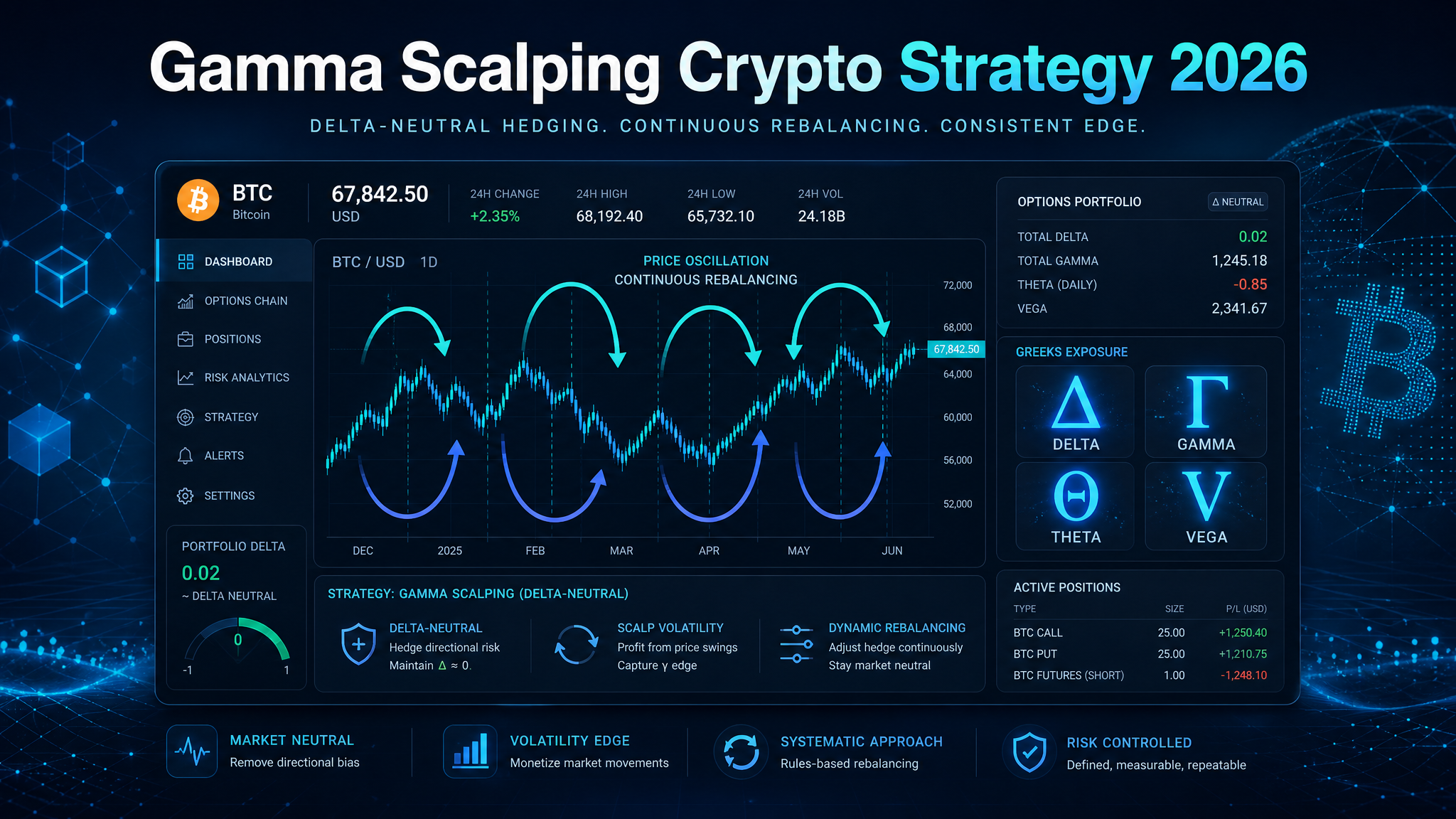
Gamma scalping is a delta-neutral options strategy. You buy an at-the-money (ATM) options position — typically a straddle (both a call and a put at the same strike) — and then continuously hedge the resulting delta exposure using spot Bitcoin or perpetual futures. As BTC's price moves, your option's delta shifts. You rebalance the hedge to stay neutral, and in doing so, you mechanically buy low and sell high on every oscillation.
Here's the elegant part: you don't need to predict whether Bitcoin goes up or down. You just need it to move. Every significant price swing generates a rebalancing trade that locks in a small profit. Do that enough times, and those small gains compound into meaningful returns.
The strategy gets its name from "gamma" — the options Greek that measures how quickly delta changes as the underlying price moves. When you're long gamma (holding options), your delta accelerates in your favor as the market moves. That acceleration is what you're harvesting.
The Options Greeks You Need to Understand First
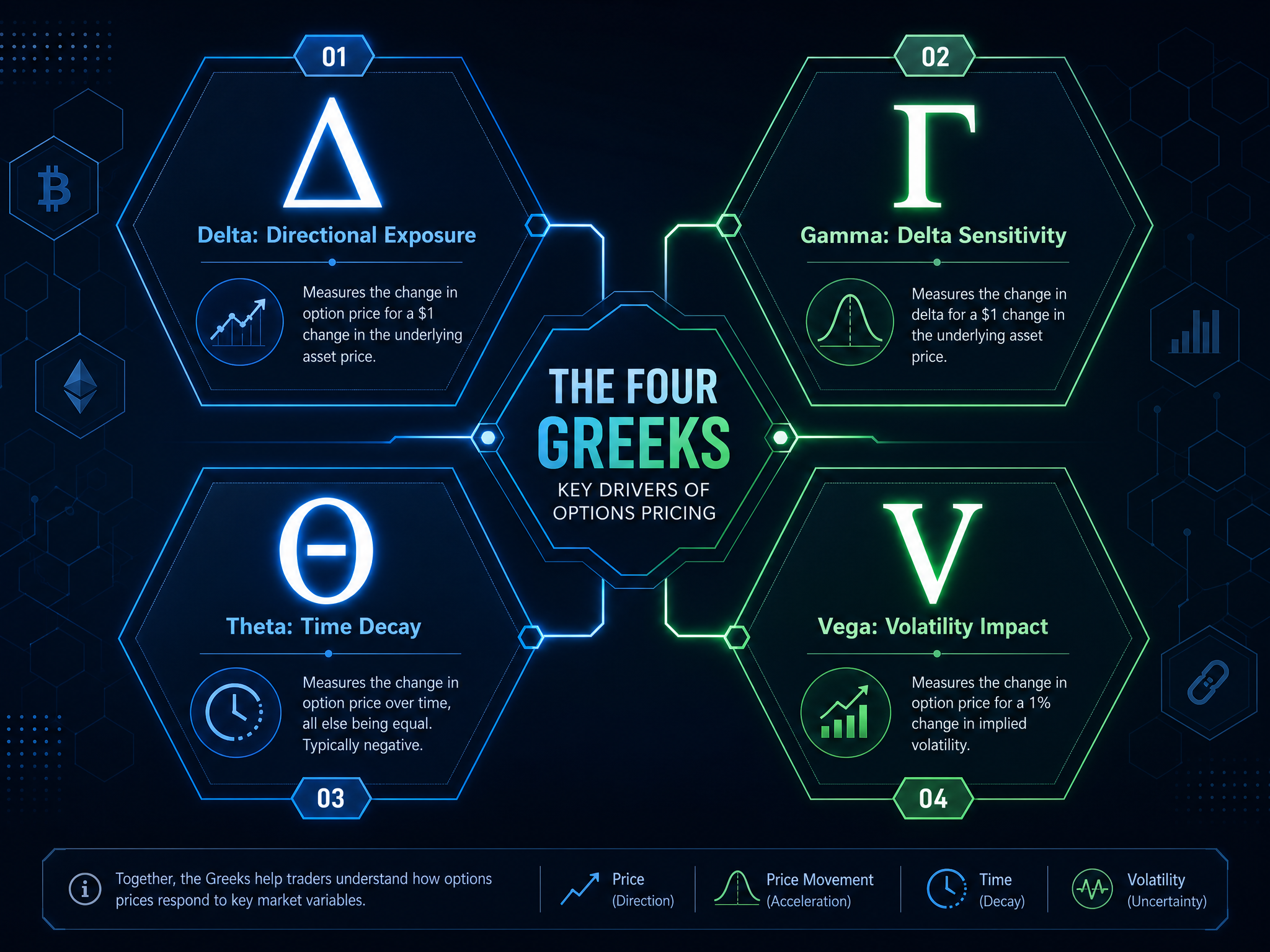
Before running this strategy, you need a working grasp of four Greeks. Not a PhD — just enough to know what's happening to your position in real time.
Delta: Your Directional Exposure
Delta measures how much your option's value changes for every $1 move in Bitcoin. An ATM call has a delta of roughly 0.50, meaning it gains $0.50 for every $1 BTC rises. When you buy an ATM straddle, the call's positive delta and the put's negative delta roughly cancel out — giving you near-zero net delta. That's your starting point.
Gamma: The Acceleration Factor
Gamma is the rate of change of delta. High gamma means your delta shifts quickly as BTC moves. Near-term ATM options have the highest gamma, which is why gamma scalpers typically target 3–7 day expiries. More gamma = more frequent rebalancing opportunities = more chances to lock in profits.
Theta: The Cost You're Paying
Theta is time decay — the daily erosion of your option's value as expiration approaches. This is the enemy of the gamma scalper. Every day you hold the position, theta chips away at your premium. Your rebalancing profits must outpace theta for the strategy to work. In crypto, theta decays 24/7 (including weekends), unlike equity options that only decay on trading days.
Vega: Implied Volatility Risk
Vega measures sensitivity to changes in implied volatility (IV). If you buy options when IV is high and it subsequently collapses — a "vol crush" — your position loses value even if BTC moves. Timing your entry when IV is relatively low (but realized volatility is expected to be high) is critical.
Step-by-Step: How to Execute a Gamma Scalp on Bitcoin
Let's walk through a concrete example. Bitcoin is trading at $108,000. You expect significant volatility over the next week — maybe a Fed announcement, a major token unlock, or just the usual weekend liquidity crunch.
Step 1: Buy an ATM Straddle
On Deribit (the dominant crypto options venue by liquidity), you buy:
- 1 BTC call option, $108,000 strike, 7-day expiry
- 1 BTC put option, $108,000 strike, 7-day expiry
Total premium paid: approximately $4,200 (this varies with current IV). Your net delta is roughly zero. You're long gamma, long vega, and paying theta daily.
Step 2: Set Your Rebalancing Rules
You need a systematic trigger for when to hedge. Two common approaches:
- Price interval method: Rebalance every time BTC moves $1,000 in either direction from your last hedge price.
- Delta drift method: Rebalance whenever your net delta drifts beyond ±0.10 from zero.
The price interval method is simpler for manual traders. The delta drift method is more precise and better suited to automated systems.
Step 3: Execute the First Hedge
BTC rises from $108,000 to $109,000. Your call's delta increases from 0.50 to 0.58, your put's drops from -0.50 to -0.42. Net delta is now +0.16. Short 0.16 BTC in perpetual futures at $109,000 to neutralize.
Step 4: Rebalance as Price Moves
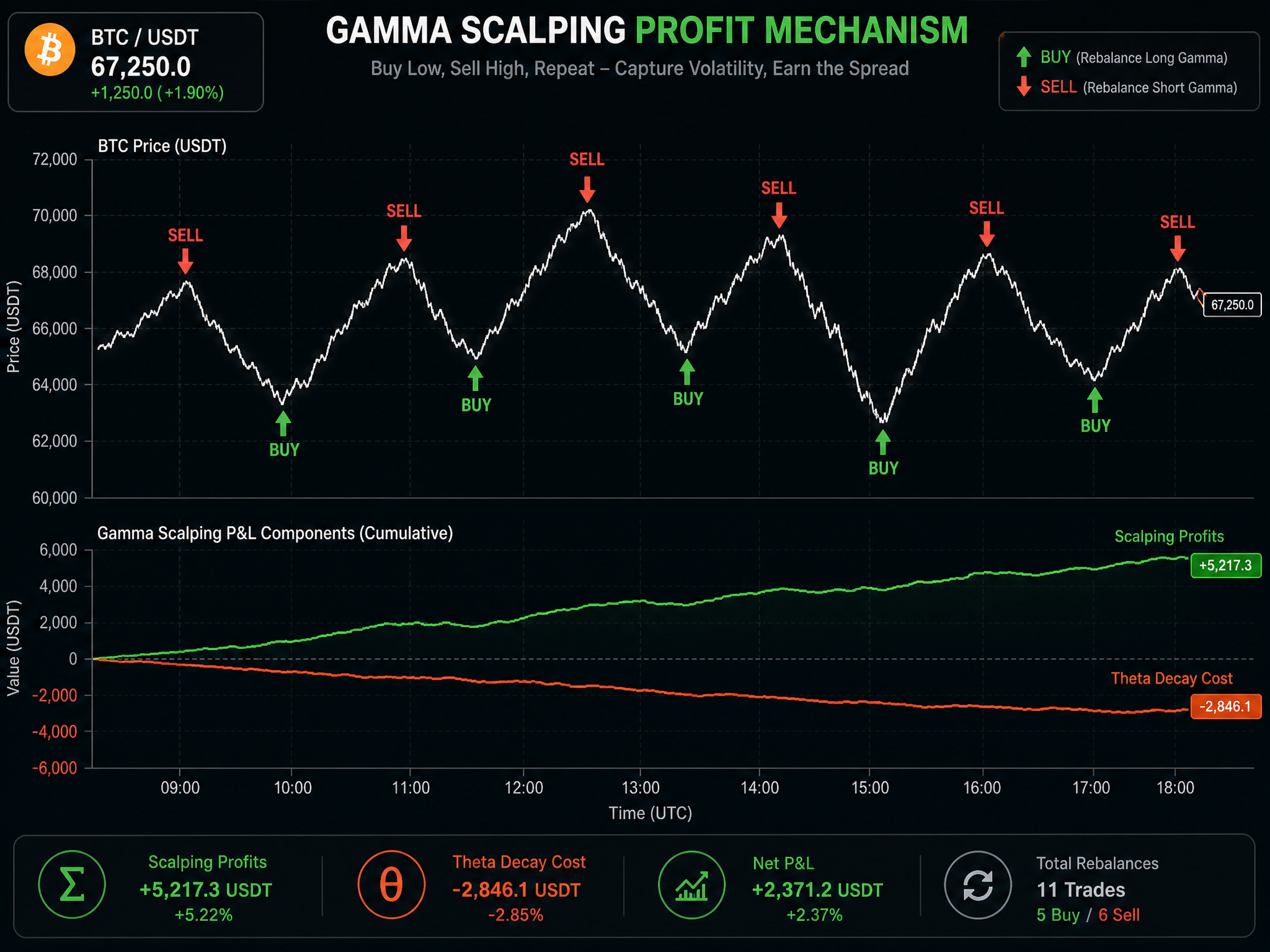
BTC drops back to $108,000. Close the short at $108,000 — that's $160 profit (0.16 BTC × $1,000). BTC drops further to $107,000, net delta goes negative, so you buy 0.16 BTC futures at $107,000. BTC bounces to $108,000 — close the long for another $160. Each oscillation generates a rebalancing profit, regardless of overall direction.
Step 5: Monitor the Break-Even Threshold
Your daily theta cost on a $4,200 straddle might be $300–$400 per day. To break even, your rebalancing profits must exceed that daily cost. If BTC is moving $1,000+ per day with multiple swings, you're likely profitable. If BTC goes completely flat for three days, theta will eat your premium.
Ready to master crypto trading? Check out Icoinpro's comprehensive trading course — it covers derivatives strategies including options fundamentals that underpin gamma scalping.
Gamma Walls and the GEX Heatmap: Your Market Intelligence Edge
One of the most powerful tools for gamma scalpers in 2026 is the Gamma Exposure (GEX) heatmap. Platforms like MenthorQ and Glassnode publish GEX data for Bitcoin options on Deribit, showing where market makers have concentrated gamma exposure.
Here's why this matters: market makers who sell options must hedge their own gamma exposure. When a large cluster of open interest sits at a specific strike — say $110,000 — market makers are forced to buy BTC as it rises toward that level and sell as it falls away. This creates a "gamma wall" that acts like a price magnet, pinning BTC near that strike.
The "Gamma Flip" level is equally important. Below the flip, market makers are net short gamma — meaning their hedging activity amplifies price moves rather than dampening them. Above the flip, they're net long gamma and act as stabilizers. Gamma scalpers want to operate in high-volatility regimes, which typically occur when BTC is below the gamma flip level.
Practical tip: check the GEX heatmap before entering a position. If BTC is pinned between two massive gamma walls with no catalyst in sight, realized volatility may stay low — bad for your theta bill. Wait for a catalyst or a regime shift.
Why Crypto Markets Are Uniquely Suited for Gamma Scalping
Traditional equity gamma scalpers face a structural problem: markets close on weekends, and overnight gaps can blow through hedge levels before you can react. Crypto eliminates this entirely — Bitcoin trades 24/7, 365 days a year. You can rebalance at 3 AM on a Sunday when a macro headline drops, with no gap risk. BTC's 30-day realized volatility in 2026 has regularly ranged between 45% and 75% annualized (vs. the S&P 500's typical 15–20%), providing far more rebalancing opportunities per day. Weekend sessions are especially productive — institutional liquidity thins out, producing sharper, faster swings that are prime hunting ground for gamma scalpers.
Risk Management: What Can Go Wrong
Gamma scalping isn't a free lunch. Three scenarios can hurt you badly:
Low Realized Volatility
If BTC barely moves for the duration of your options position, theta will destroy your premium faster than rebalancing profits can accumulate. This is the most common failure mode. Avoid entering when the market is in a confirmed low-volatility regime with no upcoming catalysts.
Volatility Crush (Vega Risk)
You buy options when IV is at 65%. A major event passes without incident, and IV collapses to 45%. Even if BTC moves, the drop in implied volatility reduces your option's value significantly. Always check the IV term structure before entering — buying into an IV spike right before a catalyst resolves is a classic mistake.
Transaction Cost Drag
Frequent rebalancing means frequent trading fees. On Deribit, taker fees run 0.03% for options and 0.05% for perpetuals. If you're rebalancing 10 times a day on a 1 BTC position, fees add up fast. Smaller accounts may find that transaction costs consume most of their scalping profits. Use limit orders where possible to earn maker rebates, and set rebalancing thresholds wide enough to avoid over-trading.
Execution Slippage
In fast-moving markets, your hedge execution price may differ from your target. Automated execution systems handle this better than manual trading — a key reason serious gamma scalpers invest in bot infrastructure.
Protect your crypto assets with a Ledger hardware wallet — the gold standard in cold storage security. When running sophisticated strategies with real capital, keeping assets in cold storage between sessions is non-negotiable.
Tools and Platforms for Gamma Scalping in 2026
Deribit: The go-to venue for crypto options — deepest BTC and ETH liquidity, full expiry suite from daily to quarterly. MenthorQ: GEX heatmaps, gamma flip levels, and dealer positioning data. Glassnode: On-chain and derivatives analytics including options open interest by strike. Delta.Exchange: Competitive alternative for ETH and SOL options. For serious practitioners, Python-based bots connected to Deribit's API can automate rebalancing, executing hedges the moment delta drifts beyond your threshold — removing emotional decision-making entirely.
Is Gamma Scalping Right for You?
This strategy is genuinely advanced — it requires solid options knowledge, real-time monitoring, and enough capital to absorb theta costs while waiting for volatility. A minimum of 0.5–1 BTC is typically needed to make the math work after fees. That said, even understanding gamma walls and the gamma flip level improves your spot trading decisions, explaining why BTC gets "pinned" at round numbers and why breakouts can be explosive once they clear a major wall.
For a structured approach to learning crypto trading, Icoinpro offers step-by-step training that has helped thousands of beginners build the foundation needed before tackling advanced strategies like this one.
Key Takeaways
- Gamma scalping profits from volatility, not direction — you need BTC to move, not to predict where.
- Buy an ATM straddle, hedge delta continuously using spot or perpetual futures as BTC oscillates.
- Theta is your cost of carry — rebalancing profits must exceed daily time decay.
- GEX heatmaps reveal gamma walls — use MenthorQ or Glassnode to time entries around volatility regimes.
- Crypto's 24/7 nature is a structural advantage — no overnight gap risk, continuous rebalancing including weekends.
- Avoid entering during IV spikes before catalysts — vol crush can wipe gains even if BTC moves.
- Transaction costs matter — use limit orders and wide rebalancing thresholds on smaller accounts.
Ready to put these strategies into practice?
The trading concepts in this article work — but only if you have the right foundation. I learned most of what I know through structured training that connected the dots between theory and live markets.
The program I recommend to people who ask me is this crypto trading course — it\'s the one I point friends and family to when they\'re serious about learning. Daily lessons, live analysis, and a community that actually helps.
Affiliate link — I may earn a commission at no extra cost to you. I only recommend what I genuinely use.
Disclaimer: The information provided on this website is for educational and informational purposes only. It should not be considered financial or investment advice. Cryptocurrency investments carry significant risk. Always do your own research and consult with a qualified financial advisor before making investment decisions.
Free Crypto Insights
Get weekly trading tips, market analysis, and exclusive strategies delivered to your inbox.