Best DEX Aggregators in 2026: Top 6 Platforms for Smarter Crypto Swaps
Affiliate Disclosure: This article may contain affiliate links. We may earn a commission at no extra cost to you. All opinions are our own.
Marcus Chen
Senior Crypto Analyst & Educator
Certified Blockchain Professional | Former Wall Street Analyst
Marcus Chen is a cryptocurrency analyst and educator with over 8 years of experience in digital asset trading. He has helped thousands of beginners navigate the crypto markets through practical, actionable education.

This article contains affiliate links. We may earn a commission at no extra cost to you if you make a purchase through these links. See our affiliate disclosure for details.
Best DEX Aggregators in 2026: Top 6 Platforms for Smarter Crypto Swaps
The best DEX aggregators in 2026 have quietly become the most important layer in decentralized trading — routing billions in daily volume across hundreds of liquidity pools so you get the best price without manually hunting across five different exchanges. If you're still swapping directly on a single DEX, you're almost certainly leaving money on the table. This guide breaks down the top six aggregators, what makes each one worth using, and which one fits your trading style.
What Is a DEX Aggregator (and Why It Matters in 2026)?
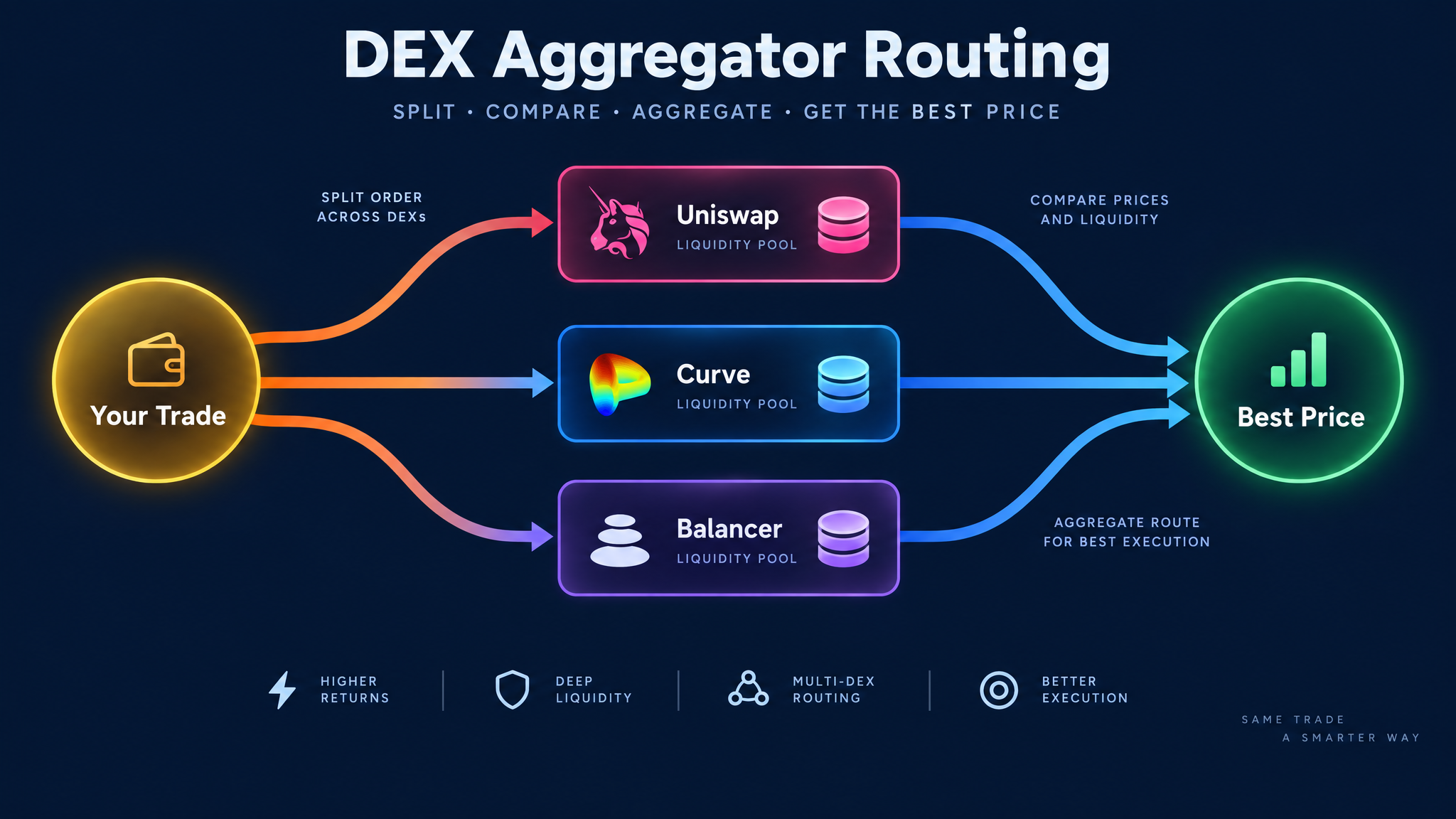
A DEX aggregator is software that scans multiple decentralized exchanges simultaneously — Uniswap, Curve, Balancer, Raydium, and dozens more — then splits and routes your trade to get the best possible execution price. Think of it like Google Flights for crypto swaps: instead of checking each airline individually, you get the best deal in one search.
In 2026, this matters more than ever. DeFi liquidity is fragmented across 100+ blockchains and thousands of pools. A $10,000 swap on a single DEX might suffer 0.8% price impact. The same trade routed through an aggregator might land at 0.2% — a $60 difference on one transaction. Do that a few times a week and the savings compound fast.
Beyond price, aggregators now handle MEV (Maximal Extractable Value) protection, cross-chain routing, gasless execution, and even limit orders. The category has matured from a convenience tool into essential infrastructure.
How We Ranked These Platforms
We evaluated each aggregator on five criteria: routing efficiency (best price vs. direct DEX), chain coverage, MEV protection, user experience, and fee transparency. We also factored in real trading volume data and security track records. No sponsored placements — just honest analysis.
The 6 Best DEX Aggregators in 2026
1. 1inch — Best Overall for EVM Chains
1inch remains the gold standard for Ethereum and EVM-compatible chains. Its "Pathfinder" routing engine splits orders across multiple pools in a single transaction, consistently beating single-DEX prices by 0.1–0.5% on mid-to-large trades. The newer "Fusion+" mode takes this further with intent-based execution: you sign an order, solvers compete to fill it at the best price, and you pay zero gas on the swap itself.
Coverage spans Ethereum, Arbitrum, Base, Optimism, Polygon, BNB Chain, Avalanche, and more — 15+ EVM networks in total. The interface is clean, the API is battle-tested (powering MetaMask Swaps and other wallets), and the security record is solid after years of audits.
Best for: Active EVM traders who want maximum price efficiency and gasless execution.
Weakness: No native Solana support; cross-chain bridging requires a separate tool.
2. Jupiter — Best for Solana
If you trade on Solana, Jupiter isn't optional — it's the default. The aggregator routes over 50% of all Solana DEX volume, pulling liquidity from Raydium, Orca, Meteora, and a dozen other pools. Execution is near-instant thanks to Solana's sub-second block times, and fees are negligible (typically under $0.01 per swap).
Jupiter has expanded well beyond basic swaps. You can set limit orders, run dollar-cost averaging (DCA) schedules, and trade perpetuals — all within the same interface. For Solana-native traders, it's a one-stop shop that's hard to beat on any metric.
Best for: Solana ecosystem traders, memecoin flippers, and anyone running DCA strategies on SOL-based assets.
Weakness: Solana-only; no EVM or cross-chain support.
3. CowSwap — Best for MEV Protection on Large Trades
CowSwap takes a fundamentally different approach. Instead of routing through existing pools immediately, it batches orders together and tries to match them peer-to-peer first — a mechanism called "Coincidence of Wants." If your buy order matches someone else's sell order at the same price, both trades settle without touching a liquidity pool at all. Zero slippage, zero MEV exposure.
When peer-to-peer matching isn't possible, CowSwap routes through a batch auction where solvers compete to fill orders at the best price. The result: sandwich attacks become structurally impossible, and large trades ($50,000+) often execute at better prices than any other aggregator.
The tradeoff is speed. CowSwap's batch auctions settle every 30 seconds, so it's not ideal for fast-moving markets. But for deliberate, large-size swaps where MEV risk is real, it's the safest option available.
Best for: Large trades ($10K+) where MEV protection is the priority.
Weakness: Slower execution; not suitable for time-sensitive trades.
4. Rango Exchange — Best for Cross-Chain Swaps
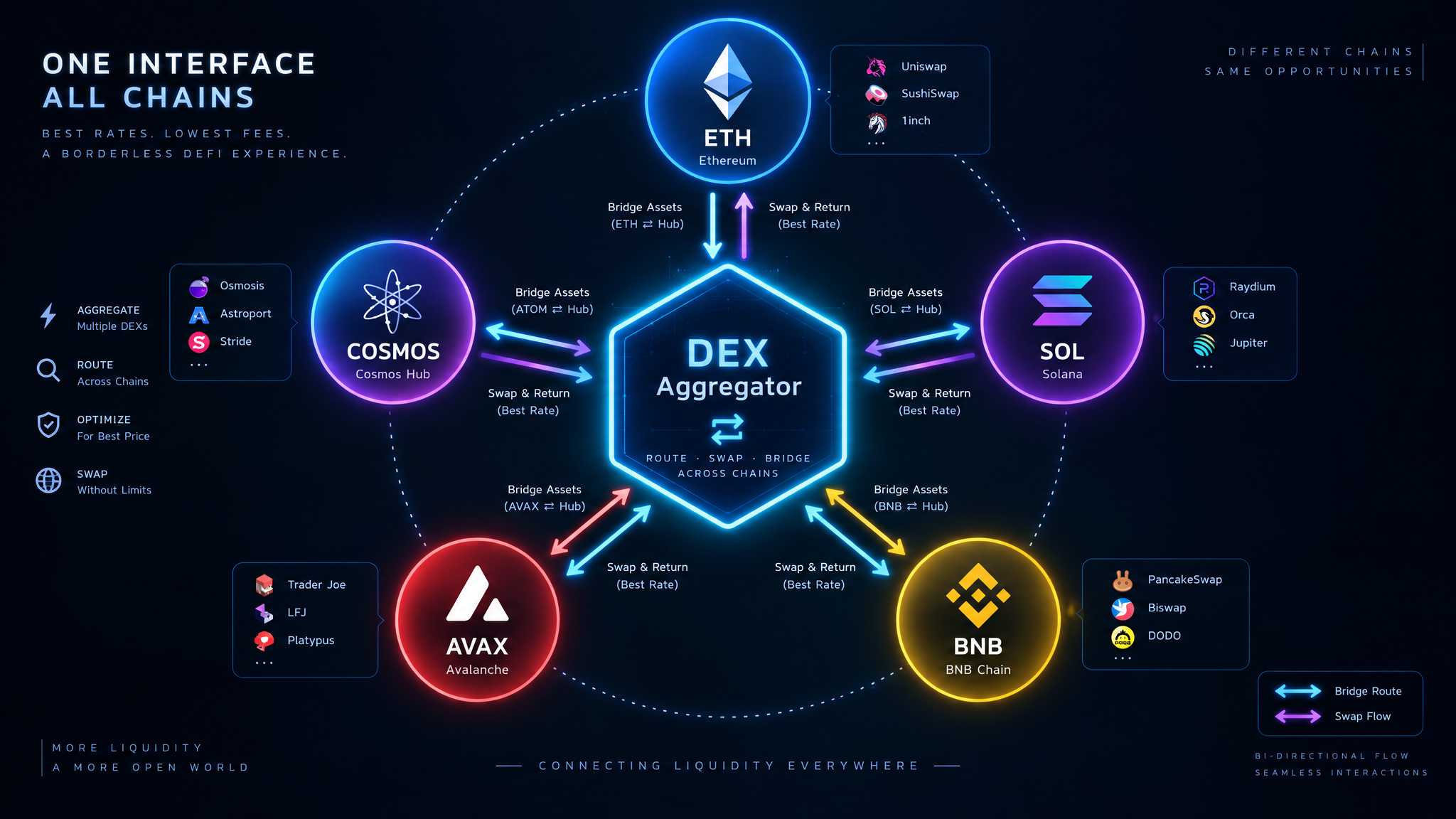
Rango solves the problem that most aggregators ignore: what happens when you need to move assets between completely different blockchain ecosystems? Not just Ethereum to Arbitrum (a simple bridge), but Bitcoin to Solana, or Cosmos to BNB Chain.
Rango aggregates 22+ bridges alongside DEX liquidity across 73+ blockchains, including non-EVM networks like Bitcoin (UTXO), Cosmos, Tron, and TON. You pick your input asset and destination, and Rango finds the optimal multi-hop route — bridging and swapping in a single transaction flow.
Cross-chain swaps carry inherent risks (bridge exploits have cost the industry billions), and Rango doesn't eliminate that risk. But it does give you the best available route with transparent fee breakdowns, which is more than most alternatives offer.
Best for: Multi-chain portfolios, cross-ecosystem arbitrage, and moving assets between non-EVM chains.
Weakness: Cross-chain routes are slower and carry bridge risk; not for quick same-chain swaps.
5. LlamaSwap — Best Free Meta-Aggregator
LlamaSwap is a meta-aggregator: it queries other aggregators (1inch, Paraswap, 0x, and more) and shows you which one offers the best price for your specific trade. No native token, no data tracking, fully open-source. It's the most transparent option in the category.
The interface is minimal by design. You won't find perpetuals, DCA tools, or cross-chain routing here. What you get is a clean price comparison across the major EVM aggregators, which is genuinely useful when you're trading significant size and want to verify you're getting the best deal.
LlamaSwap is built by the DeFiLlama team, which has a strong reputation for unbiased data. That credibility carries over — this isn't a platform trying to extract value from you.
Best for: Privacy-conscious traders and anyone who wants to verify aggregator prices before committing.
Weakness: Limited features; EVM-only; no mobile app.
6. Odos — Best for Complex Portfolio Rebalancing
Odos handles something no other aggregator does well: multi-input, multi-output swaps in a single atomic transaction. Say you want to swap ETH + USDC + WBTC into a specific allocation of ARB + OP + BASE tokens. On any other platform, that's six separate transactions with six sets of gas fees and six opportunities for price slippage. On Odos, it's one transaction.
This makes Odos uniquely powerful for portfolio rebalancing, yield farming position management, and any strategy that requires moving multiple assets simultaneously. The smart order routing is competitive with 1inch on single-asset swaps, and the multi-token capability is genuinely unique.
Coverage spans major EVM chains including Ethereum, Arbitrum, Base, Optimism, and Polygon. The interface is more technical than 1inch but well-documented.
Best for: DeFi power users managing complex multi-asset positions.
Weakness: Steeper learning curve; overkill for simple single-asset swaps.
DEX Aggregator Comparison: Quick Reference
| Aggregator | Best For | Chain Coverage | MEV Protection |
|---|---|---|---|
| 1inch | EVM multi-chain swaps | 15+ EVM chains | Fusion+ mode |
| Jupiter | Solana ecosystem | Solana only | Partial |
| CowSwap | Large trades, MEV safety | Ethereum + L2s | Structural (batch auctions) |
| Rango | Cross-chain routing | 73+ chains | Limited |
| LlamaSwap | Price comparison | Major EVM chains | Depends on routed aggregator |
| Odos | Multi-asset rebalancing | Major EVM chains | Partial |
Security Considerations Before You Swap
Aggregators are powerful, but they're not risk-free. A few things to keep in mind:
Token approvals are a real attack surface. When you approve an aggregator to spend your tokens, that approval persists until you revoke it. Use a tool like Revoke.cash to audit and clean up old approvals regularly. Set finite approvals (only the amount you're swapping) rather than unlimited ones.
Verify the interface URL every time. Phishing sites mimicking popular aggregators are common. Bookmark the official URLs and never click through from social media links. 1inch is app.1inch.io, Jupiter is jup.ag, CowSwap is swap.cow.fi.
Check price impact before confirming. Aggregators show estimated price impact — if it's above 1% on a standard trade, something is off. Either the pool is thin, or you're being routed poorly. Reduce trade size or try a different aggregator.
Bridge risk is real on cross-chain routes. Cross-chain aggregators like Rango route through bridges, and bridges have been exploited for billions. Stick to well-audited bridges (Stargate, Across, Hop) and avoid moving large amounts through newer, unaudited routes.
Which DEX Aggregator Should You Use?
The honest answer: most active DeFi traders should have two or three aggregators bookmarked, not just one. Here's a simple decision framework:
- Trading on Solana? Jupiter is your default. Full stop.
- Trading on Ethereum or L2s? Start with 1inch. Check LlamaSwap for large trades to confirm you're getting the best price.
- Moving $20K+ in a single swap? Use CowSwap for MEV protection, even if it takes 30 seconds longer.
- Moving assets between different blockchains? Rango is the most comprehensive cross-chain option.
- Rebalancing a multi-token DeFi position? Odos saves you gas and slippage with its multi-input routing.
If you're serious about improving your DeFi execution, pairing a good aggregator with a solid trading education makes a real difference. The Icoinpro One Day Trading Course covers DeFi mechanics, order routing, and risk management in a structured format — worth checking out if you want to go deeper than just knowing which button to click.
For securing the assets you're trading, a hardware wallet is non-negotiable. The Ledger hardware wallet keeps your private keys offline while still letting you sign DeFi transactions through its companion app — the right balance of security and usability for active traders.
Key Takeaways
- DEX aggregators consistently beat single-DEX prices by routing across multiple liquidity pools simultaneously.
- 1inch is the best all-around choice for EVM chains; Jupiter dominates Solana.
- CowSwap offers structural MEV protection through batch auctions — ideal for large trades.
- Rango handles cross-chain routing across 73+ blockchains including non-EVM networks.
- LlamaSwap is the best free tool for comparing aggregator prices before committing.
- Odos is uniquely suited for multi-asset portfolio rebalancing in a single transaction.
- Always revoke unused token approvals, verify URLs, and check price impact before confirming any swap.
Understanding how to get the best execution on your DeFi trades is one of those skills that pays for itself quickly. The difference between a good aggregator and a bad one — or no aggregator at all — compounds over hundreds of transactions. Pick the right tool for each trade, and your effective trading costs drop significantly.
Disclaimer: This content is for informational purposes only and should not be considered financial advice. Cryptocurrency investments carry significant risk. Always do your own research (DYOR) before making any investment decisions.
For further reading on DeFi security, check out our guide on MEV Protection strategies and our breakdown of how to use Uniswap in 2026.
DeFi moves fast. Your trading skills need to keep up.
Whether you're yield farming or trading tokens, the fundamentals of reading charts, managing risk, and timing entries apply everywhere in crypto. Those skills are worth developing properly.
The program I recommend to people who ask me is this crypto trading course — it\'s the one I point friends and family to when they\'re serious about learning. Daily lessons, live analysis, and a community that actually helps.
Affiliate link — I may earn a commission at no extra cost to you. I only recommend what I genuinely use.
Disclaimer: The information provided on this website is for educational and informational purposes only. It should not be considered financial or investment advice. Cryptocurrency investments carry significant risk. Always do your own research and consult with a qualified financial advisor before making investment decisions.
Free Crypto Insights
Get weekly trading tips, market analysis, and exclusive strategies delivered to your inbox.